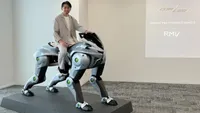
The global automotive and motorcycle landscape is on the brink of a profound paradigm shift, merging advanced robotics, alternative energy sources, and unconventional mobility concepts. Japanese manufacturing giant Kawasaki is set to capture the imagination of the engineering and motorcycling worlds at the upcoming EICMA 2026 exhibition in Milan, Italy. The company has announced plans to present a full-scale replica of the Corleo, an ambitious and futuristic quadruped robotic personal mobility vehicle that riders can straddle and operate much like a traditional horse or motorcycle.
Staged at the Fiera Milano Rho convention center from November 3 to November 8, 2026, the Kawasaki exhibition space located in Hall 11 at booth N46 will serve as the global showcase for this groundbreaking machine. While the display model will be a non-functional, full-scale replica rather than a working prototype, the presence of technical staff dispatched directly from Kawasaki’s Japanese headquarters underscores the company’s serious intent behind the project. Alongside the Corleo, Kawasaki will exhibit its comprehensive lineup of forthcoming 2027 production motorcycles alongside existing models, bridging the gap between conventional two-wheeled transport and the far-future horizon of personal robotics.
The Genesis of Corleo and the Safe Adventure Initiative
The development of the Corleo is not merely an exercise in science-fiction styling or whimsical engineering; it represents a strategic, long-term exploration into the expansion of personal mobility beyond standard internal combustion engines and conventional chassis designs. According to industry reports from Visordown, the project is spearheaded by Kawasaki’s specialized Safe Adventure Business Development team, a high-level division that reports directly to the President of Kawasaki Heavy Industries.
The overarching philosophy of the Safe Adventure initiative is rooted in the harmonization of outdoor recreation, ecological preservation, and human exploration. The concept is designed to make rugged geographical regions—such as dense forests, steep mountain ranges, and remote trails—safely accessible to humans without disturbing or degrading the natural environment. This environmental and societal mission aligns directly with the foundational pillars of the Kawasaki Group Vision 2030, a corporate roadmap focused on three distinct areas: creating a safe, secure, and remotely connected society; pioneering the future of mobility; and delivering innovative energy and environmental solutions.
By targeting a full commercialization timeline around 2035, Kawasaki is signaling that the Corleo is a multi-decade research and development undertaking. The project serves as a physical manifestation of the company’s transition toward carbon neutrality, leveraging technological synergies harvested from across Kawasaki Heavy Industries’ massive industrial footprint, which spans aerospace, heavy machinery, and advanced robotics.
Engineering and Operational Mechanics
At its technological core, the Corleo is classified as a multi-legged robotic personal mobility vehicle. The machine successfully merges the superior terrain-traversing capabilities of four-legged robotic locomotion platforms—commonly referred to in robotics as quadrupeds—with the ergonomic, dynamic principles refined by Kawasaki’s decades-long motorcycle development division.
Unlike traditional all-terrain vehicles or motorcycles that rely on wheels or continuous tracks to maintain traction, the Corleo utilizes articulated robotic limbs. This allows the vehicle to negotiate uneven surfaces, loose gravel, steep inclines, and obstacles that would typically halt conventional wheeled or tracked transport. Despite its robotic nature, the human-machine interface remains intuitively familiar to riders. Operators sit astride the machine in a traditional saddle position, directing its movement by shifting their body weight—a kinematic control mechanism that mirrors the physical engagement required when riding a horse or leaning into a motorcycle corner.
Powering this complex mechanical anatomy is an innovative hydrogen powertrain. The Corleo utilizes a compact 150 cc hydrogen internal combustion engine or fuel-cell hybrid system configured to generate electricity on demand. The fuel itself is stored securely within specialized pressurized canisters mounted at the rear of the vehicle. Hydrogen technology is a cornerstone of Kawasaki’s broader decarbonization strategy, offering the high energy density required for demanding outdoor operations without producing harmful carbon emissions.
Furthermore, Kawasaki is engineering a proprietary, highly sophisticated navigation and environmental sensing suite specifically for the Corleo. This system is designed to monitor real-time meteorological data, ambient temperatures, ground surface integrity, and even the proximity of wildlife. Critical data will be processed and relayed directly to the rider through an integrated digital instrument panel and connected smart devices, ensuring that human operators maintain situational awareness in remote and potentially hazardous environments.
Contextualizing EICMA 2026 and the Evolution of Milan’s Premier Motor Show
The selection of the Esposizione Internazionale Ciclo Motociclo e Accessori (EICMA) as the debut venue for the Corleo replica highlights the immense global prestige of the Milanese exhibition. Founded in 1914, EICMA has evolved over more than a century to become the most important and influential motorcycle and personal transport trade show in the world. Annually drawing hundreds of thousands of industry professionals, journalists, and enthusiasts to the Fiera Milano exhibition grounds, EICMA sets the technological and commercial trends for the global two-wheeled sector.
In recent years, EICMA has transcended its traditional focus on internal combustion motorcycles to become a battleground for alternative propulsion technologies, including pure battery-electric vehicles, synthetic e-fuels, and hydrogen combustion systems. By introducing a quadruped robotic mobility platform at EICMA 2026, Kawasaki is deliberately challenging industry norms and expanding the definition of what constitutes a motor vehicle exhibition. The move acknowledges that the future of personal transport in unpaved, recreational, and wilderness environments may not rely on wheels at all, but rather on biomimetic engineering.
Official Perspectives and Corporate Strategy
The unveiling of the Corleo has generated significant discussion within corporate boardrooms and engineering circles alike. Shigemi Tanaka, Managing Director of Kawasaki Motors Europe, emphasized the profound significance of the project during preliminary press disclosures.
"Corleo is a prime example not only of the depth of our unique technical, industrial, and environmental experience across the entire company, but also of our drive toward a carbon-neutral future—a future that embraces personal freedom through the Safe Adventure concept," Tanaka stated. He further noted the company’s anticipation regarding public reaction, expressing hope that visitors will share the internal team’s enthusiasm. "We expect that, alongside all our 2027 and current motorcycle models, visitors will be just as mesmerized and excited by Corleo as we are."
Tanaka’s comments underline a dual corporate strategy: maintaining commercial dominance in traditional and electrified motorcycle markets while aggressively investing in high-risk, high-reward frontier technologies that redefine human mobility.
Broader Industry Implications and Future Outlook
The public introduction of the Corleo replica in late 2026 provides clear insight into the long-term trajectory of the personal mobility sector. As urban centers become increasingly saturated and regulatory pressures mount against fossil-fuel-dependent recreational vehicles in natural parks and protected reserves, manufacturers must innovate to survive.
Quadrupedal robotics, long developed primarily for military, industrial inspection, and search-and-rescue applications by firms like Boston Dynamics, are now inching closer to consumer-facing leisure markets. By integrating a hydrogen power source, Kawasaki addresses one of the primary limitations of robotic systems: battery weight and limited operational range. Hydrogen provides the necessary energy density for extended wilderness excursions, positioning the Corleo as a viable alternative for forestry workers, eco-tourists, search-and-rescue personnel, and outdoor enthusiasts operating in terrain impassable to standard vehicles.
However, the path to commercialization by 2035 is fraught with considerable challenges. Regulatory frameworks for autonomous and robotic personal transport operating in public spaces and national parks remain largely unwritten. Safety certifications for human-occupied quadrupedal vehicles will require entirely new testing methodologies, particularly concerning dynamic stability, mechanical failure modes, and occupant protection during unexpected terrain shifts. Furthermore, the establishment of a robust hydrogen refueling infrastructure—even on a micro-scale for specialized commercial and recreational hubs—remains a formidable global hurdle.
Despite these hurdles, Kawasaki’s commitment to the Corleo project signals a bold willingness to look beyond the horizon of conventional engineering. By bridging the gap between equine movement, robotic articulation, and hydrogen energy, the Japanese manufacturer is laying the groundwork for a radical evolution in how humans navigate the untamed corners of the planet. As visitors walk the aisles of Hall 11 at Fiera Milano Rho during EICMA 2026, they will not merely be observing a static plastic and metal replica; they will be gazing directly into a conceptual blueprint for the future of exploration.