PYONGYANG — In a sharp escalation of geopolitical rhetoric on the Korean Peninsula, North Korea issued a stern warning on Monday, characterizing the recent joint military exercises conducted by the United States and South Korea as an aggressive simulation of nuclear warfare explicitly targeting Pyongyang. In response to what it perceives as an existential threat, the ruling Workers’ Party of Korea announced an accelerated timeline to radically upgrade its national nuclear deterrent capabilities.
The focal point of Pyongyang’s recent ire is the "Iron Mace" military drills, which brought together American strategic assets and South Korean conventional forces in late September. According to statements released by senior North Korean officials, these exercises validate the state’s long-held assertion that Washington harbors unyielding ambitions to dismantle the regime through preemptive nuclear aggression.
To counter this perceived alliance posture, the regime under Supreme Leader Kim Jong Un has codified a distinct three-pronged strategic doctrine aimed at neutralizing the combined nuclear-conventional deterrence framework of Washington and Seoul. This comprehensive approach encompasses the rapid quantitative and qualitative expansion of its nuclear arsenal, direct high-level oversight from core defense technology architects, and the accelerated modernization of its ballistic missile delivery systems.
Background and Context of the Iron Mace Exercises
The heightened state of alert in Pyongyang stems directly from the implementation of the "Iron Mace" operational guidelines established by the United States and South Korea. Designed to operationalize the Washington Declaration—signed by U.S. President Joe Biden and South Korean President Yoon Suk Yeol—the exercises are structured to seamlessly integrate American nuclear capabilities with South Korea’s advanced conventional military infrastructure.
The specific joint exercise referenced by North Korean state media took place between September 29 and October 2. During this window, military planners from both allied nations tested command-and-control protocols, real-time intelligence sharing, and synchronized response mechanisms intended to deter North Korean aggression. For Seoul and Washington, Iron Mace represents a necessary adaptation to Pyongyang’s evolving nuclear doctrine, which has increasingly lowered the threshold for tactical nuclear weapon deployment.
However, from the perspective of the North Korean leadership, the integration of U.S. strategic assets—such as nuclear-capable bombers, submarines, and carrier strike groups—with South Korean conventional forces fundamentally alters the strategic balance on the peninsula. Pyongyang views the exercises not as defensive deterrence, but as rehearsal operations for a decapitation strike against the leadership and vital state infrastructure.
Pillar One: Accelerated Expansion of Nuclear Weapon Capabilities
The cornerstone of North Korea’s strategic response is the aggressive expansion of its nuclear weapons stockpile and delivery infrastructure. Speaking on behalf of the regime, Kim Jong-sik, a prominent deputy department director at the ruling Workers’ Party of Korea, asserted that the Iron Mace drills provide undeniable proof that Washington’s hostile policy has reached an irreversible stage.
"The hostile forces are escalating their nuclear threats against our republic on a daily basis," Kim Jong-sik stated, emphasizing that the aggressive posture of the United States leaves Pyongyang with no diplomatic alternative other than absolute self-reliance through military might.
Defense analysts monitoring the region note that North Korea has consistently prioritized its nuclear program despite severe international sanctions and profound domestic economic hardship. In recent years, Pyongyang has diversified its nuclear portfolio beyond traditional plutonium-based warheads to include highly enriched uranium weapons and tactical nuclear warheads designed for battlefield deployment. The strategic directive following the Iron Mace exercises signals an intent to increase both the volume of fissile material production and the operational readiness of missile units tasked with executing retaliatory strikes.
Pillar Two: Direct Oversight and Elevated Role of Key Defense Technocrats
A notable and unorthodox development accompanying North Korea’s latest strategic posture is the direct public intervention of Kim Jong-sik. Traditionally, major pronouncements regarding foreign policy, defense strategy, and nuclear doctrine are funneled through the Ministry of Foreign Affairs or the Ministry of Defense. The direct engagement of a key official who oversees the technical development and production of missiles and nuclear ordnance underscores the gravity with which Pyongyang views the current security environment.
Yang Moo-jin, a professor emeritus at the University of North Korean Studies in Seoul, noted that the visible expansion of Kim Jong-sik’s portfolio reflects a broader institutional evolution within the regime. According to academic analysis, key defense technocrats are no longer confined strictly to the engineering and manufacturing sectors; their mandates have formally expanded to encompass the formulation of strategic doctrine and nuclear policy execution.
This centralization of authority ensures that technological milestones achieved by weapons laboratories are immediately integrated into operational military planning without bureaucratic friction. By placing technical commanders at the forefront of policy communication, Pyongyang signals that its military modernization is a continuous, uninterrupted pipeline from the drawing board to the launchpad.
Pillar Three: Modernization and Diversification of Ballistic Missile Systems
The third pillar of North Korea’s counter-strategy involves the continuous advancement of its ballistic missile technology to ensure survivability, penetrability, and responsiveness against sophisticated missile defense systems like the South Korean Korea Air and Missile Defense (KAMD) and the U.S. Terminal High Altitude Area Defense (THAAD).
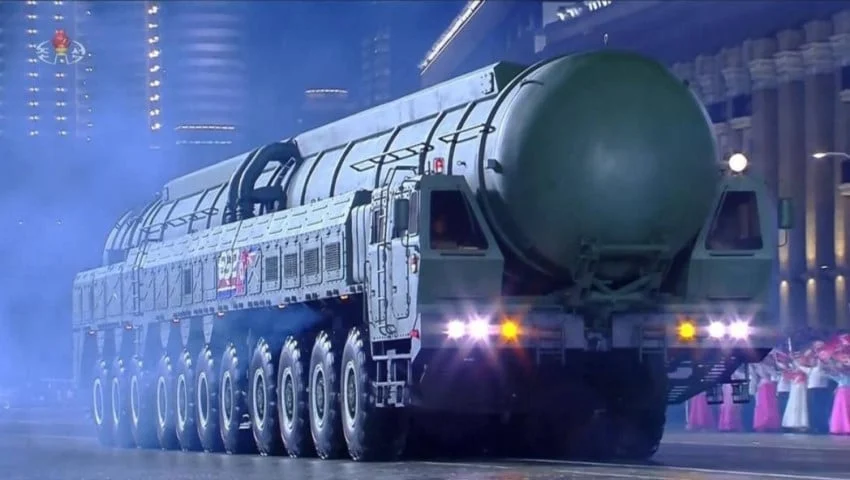
Pyongyang has systematically tested a wide array of delivery systems, ranging from solid-fueled intercontinental ballistic missiles (ICBMs) capable of reaching the American mainland to short-range hypersonic and maneuverable ballistic missiles designed to evade regional tracking radar. The integration of tactical nuclear warheads onto short-range delivery systems is viewed by military planners as a direct counterweight to the Iron Mace framework, ensuring that any conventional allied assault can be met with immediate, devastating asymmetric retaliation.
Recent Border Tensions and Psychological Warfare
The geopolitical friction surrounding the Iron Mace exercises unfolds against a backdrop of deteriorating inter-Korean relations. Tensions along the heavily fortified Demilitarized Zone (DMZ) have risen steadily following a series of border incidents, most notably a landmine detonation in September that resulted in injuries to personnel and reignited hostilities.
In the wake of these border provocations, North Korea issued threats to resume cross-border psychological warfare, specifically targeting the South with propaganda loudspeaker broadcasts by the end of October. However, military intelligence officials in Seoul reported on Monday that, despite the aggressive rhetoric, no tangible indicators have been detected to suggest that Pyongyang has operationalized its threat to reactivate the propaganda speakers.
South Korea’s Joint Chiefs of Staff maintain a heightened state of surveillance, monitoring troop movements and artillery positions along the border to detect any sudden shifts in North Korea’s tactical posture.
Implications for Regional Stability and International Diplomacy
The hardening of strategic postures on both sides of the 38th parallel paints a bleak picture for the immediate future of diplomacy on the Korean Peninsula. The institutionalization of joint exercises like Iron Mace, coupled with North Korea’s vow to exponentially expand its nuclear capabilities, creates a classic security dilemma where defensive preparations by one side are interpreted as offensive threats by the other.
International security experts warn that the complete breakdown of military communication channels between Washington, Seoul, and Pyongyang significantly increases the risk of miscalculation. Without diplomatic off-ramps or confidence-building measures, minor tactical skirmishes along the border carry a magnified risk of escalating into a broader conventional or nuclear conflict.
As the United States and South Korea continue to refine their integrated deterrence strategies, North Korea remains firmly committed to its path of nuclear self-sufficiency. The latest pronouncements from Pyongyang make it abundantly clear that the security architecture of Northeast Asia will continue to be defined by an escalating cycle of deterrence, counter-deterrence, and technological arms racing for the foreseeable future.