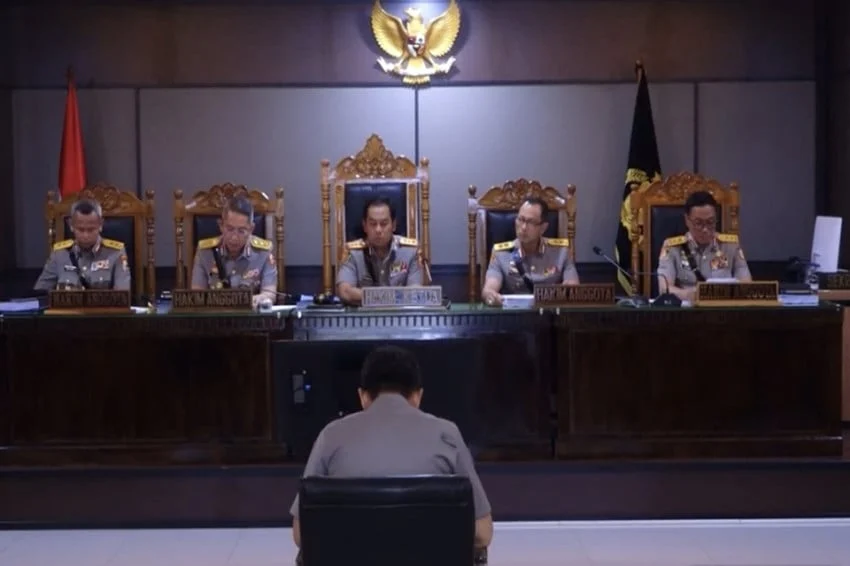
The Indonesian National Police (Polri) has delivered a decisive blow against internal misconduct by formally handing down a Dishonorable Discharge (Pemberhentian Secara Tidak Hormat, or PREDH) verdict to Inspector General Ahrie Sonta. The ruling was issued by the presiding judges of the Police Code of Ethics Commission (Komisi Kode Etik Profesi, or KKEP)
following a rigorous internal investigation and disciplinary hearing. The high-ranking police official was found culpable of severe professional ethics violations stemming from unauthorized and procedural-free wiretapping operations.
The case, which has sent shockwaves through the upper echelons of Indonesia’s law enforcement apparatus, centers on the misuse of state-of-the-art surveillance capabilities. According to official findings, the illicit activities occurred while Inspector General Ahrie Sonta was actively performing his duties in a sensitive leadership capacity within the Criminal Investigation Agency (Bareskrim Polri). The swift and severe administrative punishment underscores the institution’s stated commitment to internal accountability, transparency, and the strict adherence to the rule of law by those sworn to protect it.
Details of the Misconduct and Official Revelations
During a comprehensive press briefing held in Jakarta, Head of the Public Relations Division of the Indonesian National Police, Inspector General Johnny Eddizon Isir, laid out the core findings of the KKEP tribunal. Isir explained that the disciplinary action was triggered by concrete evidence showing that Ahrie Sonta had overstepped his lawful boundaries while serving in the critical position of Acting Head of the Monitoring Center under the Operational Bureau (Robinopsnal) of Bareskrim Polri.
"Inspector General Ahrie Sonta was found to have utilized his official authority and gained unauthorized access to technological infrastructure and devices belonging to the Indonesian National Police to conduct wiretapping operations in a manner that was entirely unprofessional and entirely contradictory to established standard operating procedures," Isir stated during the media conference.
The misuse of specialized surveillance tech represents one of the gravest breaches of internal security protocols within the police force. Wiretapping and electronic interception tools are legally restricted under Indonesian law, requiring strict authorization frameworks, judicial oversight, or specific high-level operational clearances to prevent abuses of power, protect civil liberties, and ensure that intelligence-gathering efforts remain within lawful parameters. By bypassing these mandatory checks and balances, the defendant compromised the integrity of the institution’s technical assets.
Legal Basis and Regulatory Violations
The KKEP panel’s verdict was not arbitrary but rooted firmly in existing national legislation and internal police regulations. During the proceedings, the judicial panel meticulously evaluated the evidence against statutory guidelines governing the conduct of state-sworn officers.
The tribunal concluded that Ahrie Sonta directly violated Article 13, Paragraph 1 of Government Regulation (PP) Number 1 of 2003 concerning the Dismissal of Members of the Indonesian National Police. This foundational regulation outlines the conditions under which officers can be separated from service, particularly when their continued presence brings disrepute upon the organization or constitutes a fundamental betrayal of their oath of office.
Furthermore, the violation encompassed multiple provisions within Police Regulation (Perpol) Number 7 of 2003 (subsequently updated under broader ethical guidelines, commonly referenced as Perpol Number 7 of 2022) concerning the Professional Code of Ethics and the Police Code of Ethics Commission. These regulations explicitly mandate that all personnel uphold high standards of integrity, professional responsibility, and institutional loyalty, prohibiting the unauthorized use of classified tools, intelligence systems, and operational data for purposes outside strict legal mandates.

Chronology and Background of the Investigation
The downfall of Inspector General Ahrie Sonta marks a dramatic escalation in an inquiry that had been quietly developing behind the scenes within internal oversight bodies. While public details emerged rapidly upon the conclusion of the KKEP trial, the institutional mechanisms leading to his dismissal involved months of internal auditing, forensic digital analysis, and compliance checks on Bareskrim’s technological monitoring units.
The Monitoring Center of Robinopsnal Bareskrim Polri functions as a vital nerve center, handling technical surveillance, data aggregation, and electronic intelligence required for complex criminal investigations, counter-narcotics operations, and major transnational crime probes. Because of the immense power held by personnel operating within this unit, oversight protocols are designed to be airtight.
Discrepancies in the logging of operational requests and anomalies in digital access logs first raised red flags within internal supervisory divisions. Subsequent administrative audits revealed that specific surveillance targets had been monitored without the requisite administrative documentation or legal clearances. As internal suspicion mounted, the case was escalated to the Internal Affairs Division (Divisi Propam Polri), which gathered the necessary evidentiary dossier to formally arraign Ahrie Sonta before the KKEP tribunal.
Institutional Implications and Broader Context
The dismissal of a two-star general for procedural violations in wiretapping highlights a critical juncture for the Indonesian National Police as the institution continues its broader reform agenda, often referred to as Polri Presisi (Predictive, Responsibility, and Transparency-based Justice). In recent years, public scrutiny regarding the potential overreach of intelligence and surveillance technologies has intensified across civil society and legislative bodies alike.
The unprocedural use of surveillance tools not only threatens individual privacy rights protected under Indonesian law but also exposes the internal apparatus to risks of corruption, political interference, and targeted harassment. By publicly executing a transparent trial and imposing the maximum administrative penalty—Dishonorable Discharge—the leadership of Polri aims to signal that no officer, regardless of rank or position, is immune to accountability.
Legal analysts and governance watchdogs have cautiously welcomed the decision, viewing it as a necessary step toward restoring public trust in law enforcement agencies equipped with advanced investigative technologies. However, experts emphasize that administrative dismissals must be followed by transparent criminal investigations if there is evidence that the unauthorized wiretapping involved extortion, abuse of state secrets, or other criminal offenses under the Indonesian Criminal Code (KUHP) or the Electronic Information and Transactions (ITE) Law.
Reactions and Next Steps
Following the announcement of the PTDH verdict, legal representatives for Ahrie Sonta were granted the standard right to appeal the decision through the internal appellate commission, as stipulated by police administrative procedures. However, legal experts note that overturning a unanimous KKEP ruling involving high-profile technological abuse remains an uphill battle, given the specificity of the digital forensic evidence presented during the hearings.
Meanwhile, internal oversight bodies within Bareskrim and the wider police organization are reportedly conducting a comprehensive audit of all monitoring centers and technical intelligence units nationwide. The objective of this sweeping review is to tighten access controls, implement multi-factor verification protocols for electronic surveillance tools, and ensure that no single operator can bypass the institutional chain of command to initiate wiretapping operations independently.
As the dust settles on this high-stakes internal trial, the case of Inspector General Ahrie Sonta will undoubtedly serve as a watershed moment and a cautionary tale within the ranks of the Indonesian National Police, emphasizing that the possession of extraordinary investigative powers must always be counterbalanced by rigorous oversight, strict legal adherence, and unwavering institutional integrity.