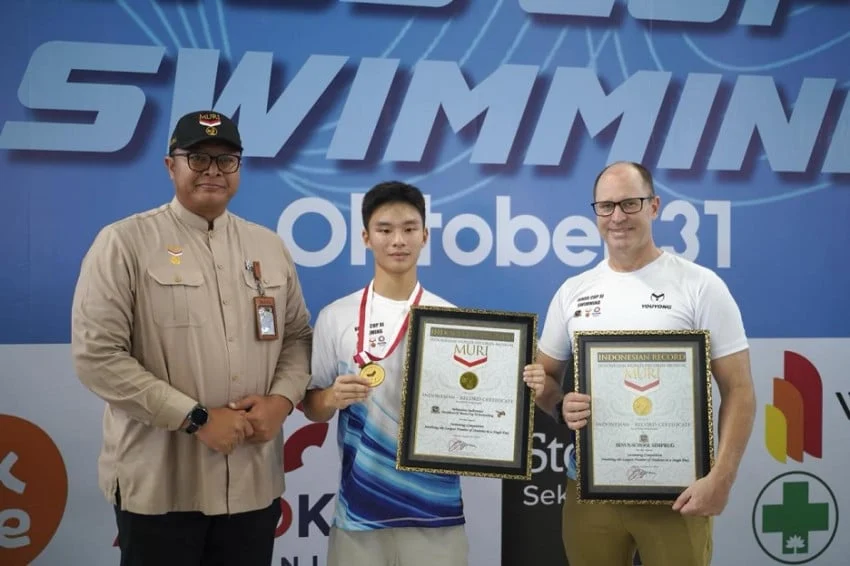
The world of youth athletics in Indonesia achieved a historic milestone on Saturday, October 31, 2026, as the BINUS Cup XI Swimming officially secured a prestigious accolade from the Indonesian World Records Museum (MURI). Staged at the iconic Aquatic Stadium within the Gelora Bung Karno (GBK) complex in Senayan, Jakarta, the grand-scale competition shattered existing benchmarks by officially registering as the Swimming Competition by the Most Students Held in a Single Day. A staggering total of 1,128 student swimmers representing diverse educational institutions across the nation converged on the world-class venue to participate in a meticulously organized day of aquatic excellence, transforming the legendary national sports hub into a vibrant arena of youthful athletic ambition.
A Grassroots Initiative Born from Student Vision
The realization of this record-breaking sporting spectacle was not merely the product of corporate event planning, but rather the culmination of visionary leadership driven by the student body of BINUS SCHOOL Simprug. Collaborating closely with the South Jakarta branch of Akuatik Indonesia, these enterprising young organizers identified a critical gap in the regional sports calendar: the pressing need for an inclusive, high-caliber interschool swimming championship open to students of all proficiency levels.
Rather than adopting a passive role, the students took complete ownership of the initiative. From the initial conceptualization phase months prior to the final whistle on competition day, the organizing committee—headed by student leader Sebastian—managed the intricate logistics, institutional outreach, and operational execution. This hands-on approach provided the student organizers with invaluable real-world experience in project management, leadership, and sports administration, while simultaneously opening wide the doors for young swimmers from various backgrounds to showcase their talents on a premier stage.
Comprehensive Competition Structure and Chronology
The one-day athletic marathon was structured to accommodate a massive influx of competitors across multiple developmental tiers, encompassing elementary (SD), junior high (SMP), and senior high school (SMA) educational brackets. To ensure fair competition and maximize participation, the event featured a rigorous program comprising 41 distinct racing numbers. These ranged across various strokes and distances, carefully curated to test both sprinting speed and endurance.
The chronology of the event began long before the crack of dawn on October 31, 2026. Months of preparatory work—including registration validation, safety compliance checks, coordination with aquatic officials, and facility staging at the GBK Aquatic Stadium—culminated in the early morning arrivals of hundreds of eager athletes, coaches, and families. By sunrise, the venue was humming with competitive energy. Warm-ups commenced sharply at scheduled intervals, followed by the opening heats that ran continuously throughout the morning and afternoon. The seamless execution of 41 racing categories within the strict temporal confines of a single day required precision timing, dedicated officiating, and flawless logistical coordination, ultimately proving that youth-led initiatives can successfully manage complex, large-scale national events.
Official Recognition and MURI Validation
The magnitude of the achievement did not go unnoticed by national record authorities. Awan Rahargo, Operations Director of MURI, was present on-site to evaluate the proceedings and officially confer the record. Addressing the participants, media, and spectators, Rahargo emphasized that the significance of the MURI certification extended far beyond the impressive numerical count of 1,128 participants.
According to Rahargo, MURI evaluates submissions based on the excellence of the endeavor and the genuine display of national youth potential. He highlighted that the record-breaking gathering was not just about setting a statistical milestone, but about establishing a sustainable pipeline for athletic talent identification. "Aside from the numbers, this is a medium and a platform to discover young talents who will become our future national swimmers, starting right here from the 11th edition of the BINUS Cup Swimming competition," Rahargo stated during the official presentation ceremony. His remarks underscored the broader strategic value of the event, positioning grassroots school competitions as the foundational bedrock for elite national sports development.
Motivations and Developmental Implications
For the organizers and participants alike, the integration of swimming into the broader BINUS Cup tradition for the very first time was designed to leave a lasting legacy. Sebastian, the chairperson of BINUS CUP XI Swimming, articulated the core motivations driving the organizing committee. He noted that because this was the inaugural inclusion of swimming in the multi-sport event, the team was determined to curate an unforgettable experience that would resonate with the competitors for years to come.
A primary objective was early-stage talent identification and athlete nurturing. However, an equally vital component of the mission was psychological: providing novice competitors—children stepping onto a competitive starting block for the very first time—with the rare opportunity to compete in the exact same arena utilized by Indonesia’s elite national athletes. By leveling the psychological playing field and placing children alongside their peers in a facility steeped in national sporting history, the event effectively demystified high-level competition and inspired a deep-seated passion for the sport.
Broader Impact on Indonesian Aquatic Sports
The successful execution of the BINUS Cup XI Swimming championship carries significant implications for the broader landscape of youth sports development in Indonesia. In recent years, sports administrators and educators have increasingly recognized that sustainable athletic excellence cannot rely solely on top-down government interventions; it requires vibrant, community-driven, and school-level ecosystems that actively engage youth at an early age.
By utilizing the Gelora Bung Karno Aquatic Stadium—a venue that meets stringent international competition standards—the organizers provided young student-athletes with crucial exposure to professional-grade infrastructure. Familiarity with such environments reduces competition anxiety, fosters professionalism among young competitors, and instills a high standard of athletic discipline. Furthermore, the collaborative framework established between BINUS SCHOOL Simprug and Akuatik Indonesia South Jakarta serves as a replicable model for future institutional partnerships, demonstrating how educational bodies and sports federations can synergize their resources to elevate youth athletics.
As the echoes of the starting buzzers fade from the GBK Aquatic Stadium and the participants return to their respective schools with newly minted experiences—and in many cases, historic memories of a MURI record—the ripple effects of BINUS Cup XI Swimming will undoubtedly be felt for years to come. The event has successfully raised the benchmark for interschool athletic competitions in Indonesia, proving that when youth are empowered to dream big and execute with precision, they can literally rewrite the record books.