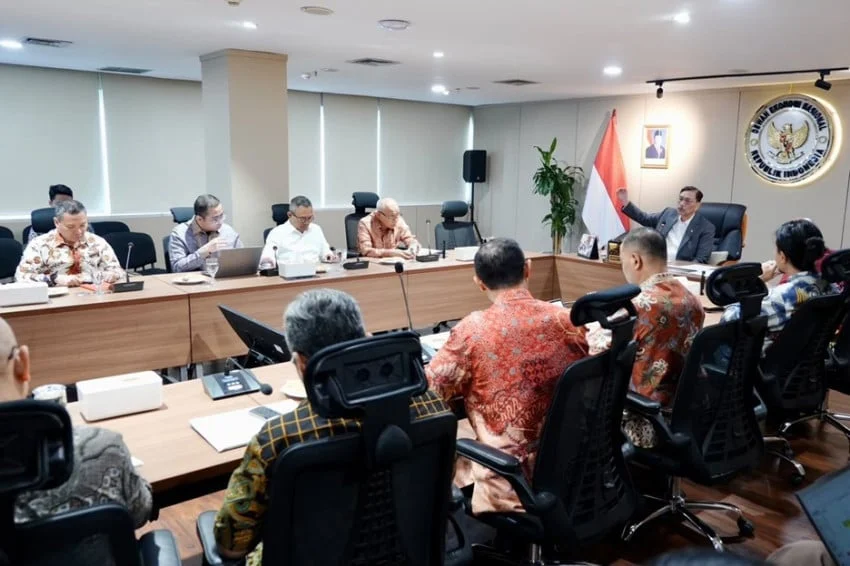
The urgent call for a comprehensive reform of Indonesia’s anti-corruption legal framework took center stage on Friday, November 6, 2026, as representatives from major university alumni associations gathered at the National Economic Council (DEN) headquarters in Jakarta. Led by the Chairman of the National Economic Council, Luhut Binsar Pandjaitan, the high-level dialogue brought together leaders from the alumni networks of the Bandung Institute of Technology (ITB), the University of Indonesia (ILUNI UI), the Sepuluh Nopember Institute of Technology (IKA ITS), Gadjah Mada University (KAGAMA), Airlangga University (IKA UNAIR), and Padjadjaran University (IKA UNPAD). The primary objective of the meeting was to address the perceived "chilling effect" that existing anti-corruption regulations, specifically the Law on the Eradication of Criminal Acts of Corruption (UU Tipikor), have imposed on the professional decision-making process within Indonesia’s public and state-owned enterprise (SOE) sectors.
The Core Conflict: Criminalizing Business Judgment
At the heart of the discussion was the argument that the current interpretation of corruption laws—specifically the provisions regarding "state financial losses"—has become overly broad, frequently conflating legitimate business risks and administrative errors with intentional criminal activity. Boy Robyanto, Vice Chairman of IKA ITS, spearheaded the discourse by emphasizing that the ambiguity surrounding these laws has created a climate of fear among executives and public officials.
"The lack of clarity in how corruption laws are applied, particularly concerning what constitutes a ‘state loss,’ has introduced profound uncertainty for those tasked with managing Indonesia’s State-Owned Enterprises," Robyanto stated during the session. He argued that when professional managers fear that every business decision—if it fails or results in a loss—could be prosecuted as a criminal act of corruption, they become paralyzed. This systemic risk aversion does not merely hinder the performance of BUMNs; it stifles innovation, slows down essential public infrastructure projects, and ultimately degrades the competitiveness of the national economy on a global scale.
Legal Transition and the Shift to the New Criminal Code (KUHP)
The debate takes on added significance due to the ongoing legal transition in Indonesia. The provisions previously governed by Articles 2 and 3 of the UU Tipikor are currently being integrated into the newly enacted Criminal Code (KUHP) under Articles 603 and 604. Alumni representatives expressed concern that if the interpretative flaws present in the old law are carried over into the new code, the legal stalemate will persist.
Robyanto specifically called for a more refined definition of the "elements of state loss," "unlawful acts," and "criminal intent." The goal is to establish a clear legal boundary that distinguishes between a standard administrative failure, a legitimate business venture that resulted in a loss, and a genuine act of embezzlement or graft. Without this distinction, professionals in the public sector are essentially operating under a regime where every economic decision is potentially subject to criminal review, a scenario that is increasingly being viewed as incompatible with the modern, professional management of state assets.
Contextualizing the Call for Reform: International Best Practices
The push for legislative reform is grounded in Indonesia’s long-standing commitment to international standards. Indonesia officially ratified the United Nations Convention Against Corruption (UNCAC) in 2006 via Law Number 7 of 2006. As the nation approaches two decades of being a signatory to this global treaty, proponents of the reform argue that Indonesia should shift its focus from a purely punitive approach to a more holistic strategy that incorporates international best practices.
The international consensus on anti-corruption, as reflected in various OECD and UNCAC guidance documents, emphasizes the need for proportionality and the protection of the "business judgment rule." This rule suggests that courts should not second-guess the good-faith business decisions of directors, even if those decisions subsequently result in financial losses. By aligning its local enforcement practices with these international benchmarks, Indonesia could potentially foster a more robust investment climate, as foreign and domestic investors alike would gain greater confidence in the predictability of the Indonesian legal system.
Case Study: The Pelindo Precedent
To illustrate the systemic issues at play, Robyanto highlighted the legal challenges faced by professionals at the state-owned port operator, Pelindo. The case involves PT APBS, a subsidiary of Pelindo, which undertook dredging operations at the Tanjung Perak Port. While the project was completed and provided demonstrable operational benefits to the port, the company’s corporate gains were targeted by investigators on the grounds that the procurement process had procedural irregularities.
In this instance, the judiciary determined that while the defendants did not enrich themselves personally, their actions constituted an "unlawful act" that benefited the corporation, thus triggering the anti-corruption statutes. This case serves as a poignant example for critics of the current law: it highlights a situation where the successful delivery of a public service was overshadowed by a criminal prosecution focused on administrative discrepancies. For many in the business community, this creates an untenable situation where "success" in a business sense is irrelevant to "guilt" in a legal sense, provided there was a deviation from strict administrative protocols.
Official Response and the Role of the National Economic Council
Luhut Binsar Pandjaitan’s involvement as the Chairman of the National Economic Council underscores the government’s acknowledgment that legal reform is now inextricably linked to economic performance. The DEN acts as an advisory body to the President, tasked with synthesizing economic data and policy recommendations to ensure sustainable growth. By hosting this dialogue, the DEN has signaled that the administration recognizes the "corruption-phobia" currently gripping the public sector as a structural bottleneck to the national development agenda.
While the government has not yet released a formal draft of proposed legislative amendments, the consensus reached during the Friday meeting suggests that a multi-stakeholder approach will be adopted. This would likely involve a task force comprising legal experts, economists, and representatives from the Attorney General’s Office and the Corruption Eradication Commission (KPK) to review how the new KUHP can be applied without undermining the essential goal of corruption prevention.
Broader Implications for the Indonesian Economy
The potential reform of the UU Tipikor carries significant weight for Indonesia’s 2045 Golden Indonesia (Indonesia Emas) vision. If the country aims to transition from a middle-income to a high-income economy, it must manage its vast array of state-owned assets with high efficiency. Data from the Ministry of State-Owned Enterprises indicates that BUMNs contribute significantly to the national GDP and are the primary drivers of infrastructure development. When the leadership of these entities is hampered by the fear of criminal prosecution, the entire chain of public service delivery slows down.
Economic analysts observe that the "chilling effect" has already led to a slowdown in capital expenditure across several ministries and SOEs. Decision-makers often prefer to leave budgets unspent rather than risk a procurement process that could be scrutinized years later by auditors or prosecutors. This "inaction" is, in its own right, a form of economic loss that arguably causes more damage to the public interest than the administrative errors the law seeks to prevent.
Next Steps: A Path Toward Legislative Clarity
The discourse initiated by the university alumni associations is expected to escalate in the coming months. The following phases are anticipated in the ongoing effort to reconcile anti-corruption enforcement with business reality:
- Technical Review: A formal review of the transition from UU Tipikor to the new KUHP to identify specific articles that require interpretative guidelines (Peraturan Pemerintah or Mahkamah Agung circulars).
- Public Consultation: Expanded dialogues involving the Indonesian Chamber of Commerce and Industry (KADIN) and other professional bodies to ensure that the private sector’s perspective on business risk is fully integrated.
- Judicial Training: Developing specialized training programs for prosecutors and judges to ensure they have a nuanced understanding of corporate governance, business judgment, and the difference between administrative non-compliance and criminal corruption.
- Legislative Amendment: Should the interpretative guidelines prove insufficient, the government may propose targeted revisions to the criminal code to explicitly define "state financial loss" in a way that protects professional good-faith efforts.
As the debate continues, the fundamental challenge for Indonesia remains balancing the mandate to eradicate systemic corruption with the need to build a modern, efficient, and professional bureaucracy. The meeting on November 6 has effectively moved the needle, positioning the legal framework not just as a tool for punishment, but as a potential instrument for enhancing institutional integrity and economic vitality. By addressing the concerns of the nation’s professional class, the government is looking to ensure that the fear of the law does not replace the courage to lead.