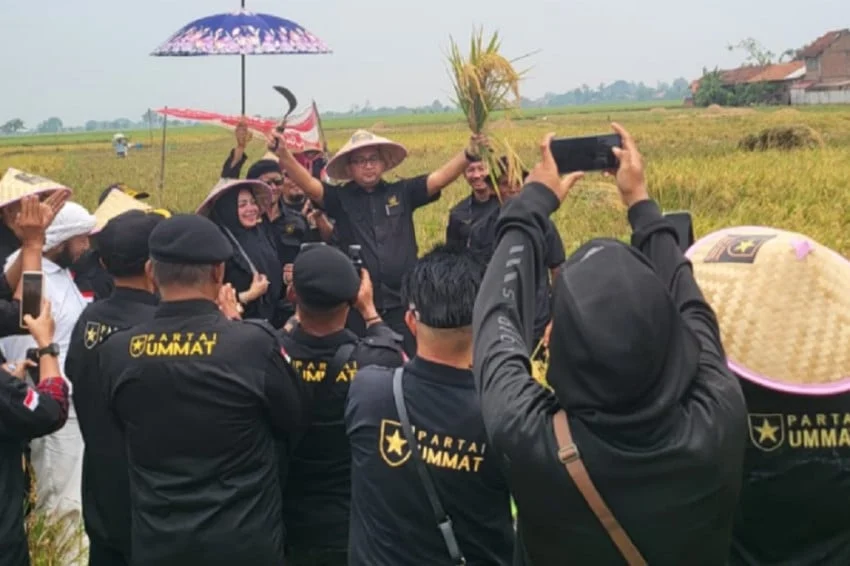
In a strategic move to address the ongoing challenges of agricultural sustainability and food security in Indonesia, Heikal Safar, the Daily Chairman of the Central Executive Board (DPP) of the Ummat Party, led a large-scale harvest ceremony and community outreach event in Sukamulya Village, Sukatani District, Bekasi Regency. The event, which brought together hundreds of local farmers, was designed not only to celebrate the seasonal yield but to serve as a platform for advocating for the empowerment of the agricultural sector, which remains the backbone of the nation’s socio-economic stability.
The Scope of the Event and Community Engagement
The panen raya, or grand harvest, was held in the heart of Bekasi’s agricultural belt, a region that serves as a critical buffer for food supplies in the Greater Jakarta area. Heikal Safar was accompanied by Nofalia Heikal Safar, the Chairperson of the Economic Empowerment Commission of the DPP Ummat Party. Their presence signaled a concerted effort by the party to bridge the gap between policy discourse at the national level and the ground-level realities faced by rural farmers.
The event was attended by a broad coalition of stakeholders, including representatives from the Ummat Party’s regional boards in both Bekasi Regency and Bekasi City, as well as prominent local figures, including Ustaz Haryono. The inclusion of farmer cooperatives and groups under the guidance of the Ummat Party highlighted a collaborative approach to resource management. Beyond the ceremony, the delegation hosted a free communal lunch, an initiative aimed at fostering solidarity and providing immediate support to the families of local farmers who work tirelessly to maintain the region’s output.
Contextualizing Indonesia’s Agricultural Challenges
The urgency of the event in Sukamulya is rooted in a broader national narrative regarding food sovereignty. While Indonesia has made significant strides in increasing the production of staple crops over the past two years, the agricultural sector faces persistent hurdles. According to recent data from the Ministry of Agriculture, while the production of eight major commodities—including rice, corn, and soybeans—has seen an upward trajectory, the efficiency of distribution and the welfare of smallholder farmers remain points of contention.
Heikal Safar emphasized that the prosperity of farmers is currently uneven across the archipelago. He noted that despite the government’s push for self-sufficiency, many farmers continue to struggle with fluctuating market prices, the rising costs of fertilizers, and the transition toward modernized agricultural practices. During his address to the farmers, Safar stressed that Indonesia must urgently modernize its agricultural framework to remain competitive. He specifically pointed to regional peers like Thailand and Vietnam, which have successfully integrated advanced technology and high-yield crop varieties to dominate rice export markets in Southeast Asia.
Comparative Analysis: Indonesia, Thailand, and Vietnam
The comparison drawn by Safar touches upon a critical reality in global food security. Thailand and Vietnam have long been benchmarks for agricultural efficiency. In Thailand, the "Smart Farmer" initiative has successfully digitized supply chains, allowing for real-time tracking of crop health and market fluctuations. Vietnam, on the other hand, has focused heavily on land consolidation and intensive investment in irrigation infrastructure.
In contrast, Indonesia’s agricultural landscape is characterized by high fragmentation. Many farmers operate on small plots of land, which limits the potential for economies of scale. When machinery and modern technology are introduced in these settings, the impact is often diluted by the lack of infrastructure and access to affordable capital. The Ummat Party’s intervention in Bekasi aims to promote a model of "community empowerment," where farmers are not treated as isolated units but as part of a collective network that shares equipment, knowledge, and bargaining power.
Economic Implications and Food Security
The strategic importance of Bekasi in this context cannot be overstated. As urban sprawl from the Jakarta metropolitan area continues to encroach upon fertile land, the preservation of agricultural zones has become a matter of national security. The loss of arable land in West Java directly impacts the national rice stockpile.
From an economic perspective, the empowerment of farmers directly correlates with poverty reduction. Statistics indicate that a significant portion of Indonesia’s rural poor are engaged in agriculture. By focusing on productivity—through better irrigation, the adoption of climate-resilient seeds, and improved post-harvest processing—the Ummat Party argues that the agricultural sector can serve as a primary engine for regional economic growth.
The "makan siang gratis" (free lunch) program conducted during the event also carries symbolic and practical weight. In many rural communities, the period between harvests is a time of financial vulnerability. By providing direct support and engaging in dialogue, political entities like the Ummat Party are attempting to reposition themselves as advocates for the agrarian class, moving beyond traditional political campaigning into the realm of grassroots economic facilitation.
Timeline of Recent Developments in the Sector
- Year 1 (National Policy Shift): The government intensified the "Swasembada Pangan" (Food Self-Sufficiency) program, allocating significant subsidies for fertilizers and agricultural machinery.
- Early Year 2 (Infrastructure Push): Emphasis was placed on repairing irrigation systems across Java and Sumatra, which saw some relief in water scarcity issues during the dry season.
- Current Period (The Bekasi Event): Focus shifts to the mobilization of community groups and political oversight to ensure that national subsidies reach the grassroots level effectively.
Official Responses and Future Outlook
While political observers note that such events are part of the broader effort to build electoral support, the focus on food security resonates across the political spectrum. Experts in agricultural policy suggest that for initiatives like those of the Ummat Party to have a lasting impact, they must transition from one-off events to sustained programs that offer long-term financial credit and technical training.
In his concluding remarks, Heikal Safar stated that the Ummat Party is committed to lobbying for policies that prioritize the protection of domestic farmers from the volatility of imported food products. He called for a more robust regulatory framework that ensures farmers receive a fair share of the value chain, rather than losing the majority of their profit to intermediaries.
The event in Sukamulya concludes with a clear call to action: the modernization of Indonesian agriculture is not just an technological imperative but a humanitarian one. As the nation faces global climate uncertainties—including unpredictable rainfall patterns and shifting crop disease profiles—the resilience of the agricultural sector will be the primary determinant of Indonesia’s future prosperity.
The Broader Impact: Sustainability and Resilience
The long-term success of the initiatives highlighted by the Ummat Party will depend on three pillars: technological integration, land tenure security, and market access.
- Technological Integration: The adoption of IoT (Internet of Things) devices for soil analysis and drone-based pesticide application is no longer a luxury but a necessity to compete with Vietnam and Thailand.
- Land Tenure: As land in areas like Bekasi becomes more valuable for industrial and residential development, the government must provide stronger incentives for farmers to remain on their land, perhaps through tax breaks or agricultural zoning protections.
- Market Access: Strengthening the role of cooperatives will allow farmers to bypass middlemen, ensuring that the prices consumers pay in the city reflect a fair wage for the producer.
In conclusion, the panen raya in Bekasi serves as a microcosm of the larger struggle for food security in Indonesia. It highlights the dedication of the farming community and the growing recognition by political leaders that the path to a stable, food-secure nation must begin in the fields. As the discourse surrounding food sovereignty intensifies, the ability of both government and political parties to deliver on these promises will remain a critical metric for public trust and economic stability in the years to come. The Ummat Party’s involvement, through its focus on community empowerment and economic advocacy, reflects a growing trend of political parties moving to engage with the specific, material needs of the agricultural workforce in a rapidly urbanizing Indonesia.