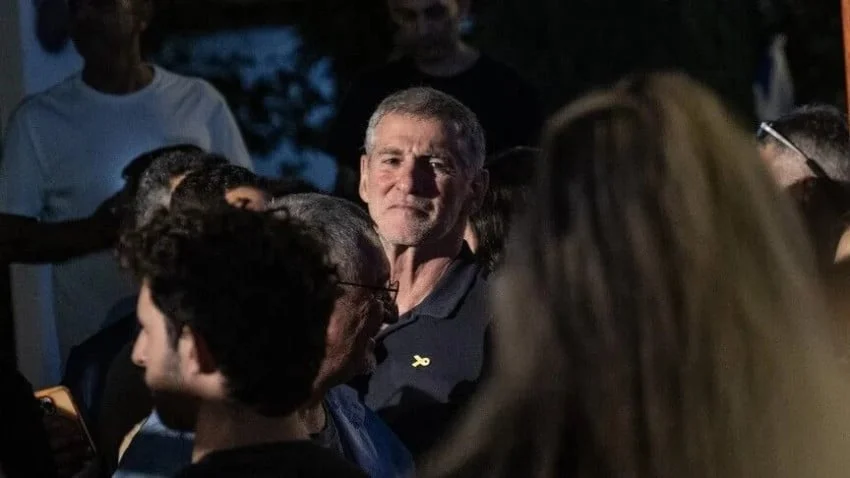
An apparent assassination or stabbing attempt targeting prominent Israeli opposition figure and Democratic Party leader Yair Golan was successfully thwarted on Tuesday, October 27, 2026, during a public campaign event in Tel Aviv. The incident, which unfolded at the bustling Railway Park, highlights the increasingly volatile and polarized political climate within Israel, where heated rhetoric and deep societal divisions have occasionally spilled over into threats of physical violence against public officials. According to local media reports, law enforcement authorities swiftly intervened and detained a male suspect who was found in possession of a large knife while aggressively approaching the opposition leader.
The confrontation underscores mounting security concerns for high-profile political figures in the country, particularly those leading opposition movements against the current government coalition. While the prompt and decisive action of Golan’s private security detail prevented physical harm, the event has sent shockwaves through the Israeli political landscape, prompting widespread condemnation from across the ideological spectrum and renewed calls for heightened security measures for elected officials and political candidates alike.
Chronology of the Incident at Railway Park
The sequence of events began during a routine mobile voter mobilization campaign organized by the Democratic Party at Railway Park, a popular public recreational area in central Tel Aviv. Yair Golan, a former Deputy Chief of Staff of the Israel Defense Forces (IDF) and a vocal critic of the sitting administration, was actively engaging with constituents and supporters as part of ongoing grassroots political outreach.
According to an official statement released by the Democratic Party, the situation escalated rapidly when an unidentified individual, heavily clad in a jacket despite the prevailing weather conditions, began moving purposefully through the crowd. The suspect reportedly ignored standard social boundaries and advanced directly toward Golan in a manner deemed immediately threatening by the security personnel assigned to protect the opposition leader.
Sensing imminent danger, Golan’s detail moved swiftly to intercept the individual before he could close the distance to the politician. As the security agents engaged the suspect, a large knife fell from his clothing, confirming their suspicions regarding his hostile intent. The trained security team immediately overpowered and immobilized the man, neutralizing the threat within seconds. Local police authorities were promptly notified, and officers arrived at the scene shortly thereafter to take the suspect into custody. Officials confirmed that no injuries were sustained by Golan, his security team, or members of the surrounding public during the brief yet harrowing encounter.
Background Context and Political Climate in Israel
To fully understand the gravity of the incident involving Yair Golan, it is necessary to examine the broader sociopolitical context in Israel leading up to late 2026. The nation has experienced prolonged periods of intense domestic friction, driven by contentious judicial reform debates, divergent visions for national security, and sharp disagreements over government handling of regional conflicts.
Yair Golan has long been a polarizing yet formidable figure in Israeli politics. A decorated military veteran who rose through the ranks of the IDF, Golan transitioned into civilian politics with a reputation for outspokenness. As the leader of the Democratic Party—a faction formed through the consolidation of various center-left and progressive political elements—Golan has consistently positioned himself as a fierce opponent of the current governing coalition. He has frequently organized and addressed large-scale anti-government protests, advocating for democratic preservation, civil liberties, and sweeping political change.
In recent years, the intersection of intense political polarization and widespread proliferation of personal security details for Israeli politicians has become increasingly pronounced. Threats against lawmakers, both within the coalition and the opposition, have seen a measurable rise, fueled by vitriolic rhetoric on social media and public platforms. Security agencies, including the Shin Bet (Israel Security Agency) and municipal police forces, have routinely flagged the potential for politically motivated violence, prompting strict threat assessments for prominent figures participating in public events.
Official Responses and Statements from Political Figures
In the wake of the thwarted attack, statements poured in from various political leaders, civil society organizations, and international observers expressing shock and condemnation.
The Democratic Party issued a formal communique detailing the heroism of the security detail and reaffirming Golan’s commitment to democratic engagement. The party emphasized that intimidation and violence would not deter their political movement from continuing its grassroots campaign efforts across the country. "Our security team acted with exemplary professionalism, preventing what could have been a national tragedy," the statement read. "Yair Golan remains undeterred and will continue to meet with the Israeli public to advocate for the democratic future of our nation."
While initial statements from law enforcement confirmed the arrest of the suspect, police spokespersons noted that a comprehensive investigation is currently underway to determine the exact motives behind the attempted assault. Investigators are examining whether the suspect acted as a lone wolf driven by personal ideological grievances, or if there were any external instigators or accomplices involved in planning the confrontation. As of late Tuesday, investigators had not released further details regarding the identity or background of the detainee, citing the ongoing nature of the inquiry and the need to verify all potential leads.
Broader Implications and Impact on Israeli Democracy
The attempted stabbing of Yair Golan carries significant implications for the future of political campaigning, security protocols, and public discourse in Israel. Analysts suggest that the incident could serve as a watershed moment, compelling political parties to reevaluate the safety measures surrounding public rallies, town halls, and street-level voter outreach programs.
-
Escalation of Security Protocols: Political campaigns in Israel have traditionally prided themselves on accessibility, allowing citizens to interact closely with their elected representatives and candidates. However, incidents of targeted violence and threats often force campaigns to adopt more restrictive security measures, potentially widening the physical and psychological gap between politicians and the electorate. Security experts anticipate that the Israel Police and private security contractors will mandate enhanced screening, restricted perimeters, and increased intelligence-sharing for high-profile public events moving forward.
-
Impact on Political Rhetoric: The bipartisan condemnation that followed the incident underscores a shared recognition of the dangers posed by unchecked political hostility. Leaders from across the political spectrum—including figures who frequently clash with Golan on policy matters—issued statements rejecting political violence. Sociologists and political scientists note that while such consensus is vital for national stability, sustained efforts will be required to tone down inflammatory rhetoric that creates an environment where physical attacks are perceived as viable by disgruntled individuals.
-
Resilience of the Democratic Process: Despite the inherent risks highlighted by the event, political analysts observe that opposition figures like Golan are unlikely to retreat from the public sphere. Public visibility is a critical component of democratic competition, and retreating behind closed doors would signal a victory for those seeking to silence political dissent through intimidation. Consequently, the incident is expected to galvanize Golan’s supporters, reinforcing solidarity within the Democratic Party and prompting renewed discussions on the fundamental protections required to maintain a vibrant, open democracy.
Conclusion
The averted attack on Yair Golan at Tel Aviv’s Railway Park serves as a sobering reminder of the fragile state of security surrounding political figures amid deep societal divisions. While the swift action of security personnel averted physical tragedy, the event leaves a lasting mark on the 2026 political season. As police investigations continue to probe the suspect’s background and intentions, the broader Israeli society is once again forced to confront the critical imperative of safeguarding democratic institutions, protecting public servants, and fostering a political culture rooted in debate rather than violence.