Access to quality healthcare remains a fundamental challenge for numerous underserved communities across Indonesia, particularly when it comes to specialized medical services such as ophthalmology. Addressing this critical healthcare gap, JEC Eye Hospitals and Clinics joined forces with the Parent Teacher Association (PTA) Secondary Syafana Islamic School to host a comprehensive free eye examination social program. The philanthropic initiative, carrying the unifying theme Seeing More Clearly, Sharing More Broadly, took place on Saturday, October 24, 2026, at the Syafana Islamic School Secondary Campus located in Lengkong Kulon, Pagedangan, within the Tangerang Regency area.
This collaborative community outreach program was designed to target between 250 and 300 beneficiaries, focusing specifically on groups often facing barriers to routine medical check-ups. The primary recipients of this healthcare intervention included teaching staff, school administrators from the Syafana Islamic Boarding School, underprivileged individuals from surrounding neighborhoods categorized under the dhuafa group, and young students from the Atta’awun Educare Campus in Lengkong. By bridging the accessibility divide, the initiative aimed to ensure that vulnerable populations receive essential vision diagnostics that are crucial for daily functioning, education, and overall well-being.
The Genesis of the Initiative: Aligning with Global Vision Awareness Campaigns
The timing of the October 2026 event was strategically planned to coincide with ongoing global public health observances. Specifically, the initiative served as an extension of the momentum generated by World Sight Day 2026, which was globally commemorated on October 8 under the international advocacy banner of Love Your Eyes. This global campaign emphasizes the critical importance of prioritizing ocular health, encouraging proactive self-care, and eliminating avoidable vision impairment worldwide.
By localizing this global mission, JEC Eye Hospitals and Clinics and the PTA Secondary Syafana Islamic School sought to bring professional eye care directly to the grassroots level. Vision screening programs of this scale are vital in identifying uncorrected refractive errors and early-stage ocular pathologies that might otherwise go unnoticed until they severely impact an individual’s quality of life. The event provided participants with a multi-layered healthcare experience, beginning with computerized and professional screenings via EyeCheck, followed by the direct distribution of complimentary prescription eyeglasses to those diagnosed with visual impairments, and concluding with comprehensive educational sessions on ocular hygiene.
Chronology and Execution of the Vision Screening Program
Preparations for the large-scale social event began months in advance through a collaborative planning process between the medical logistics team at JEC Eye Hospitals and Clinics and the social affairs division of the PTA Secondary Syafana Islamic School. On the morning of Saturday, October 24, 2026, the Syafana Islamic School Secondary Campus was transformed into a temporary, fully-equipped clinical screening hub.
Registration for the targeted 250 to 300 participants commenced at 8:00 AM local time, managed by school volunteers and administrative staff who coordinated the flow of attendees. Participants were first led through an educational briefing area where they learned fundamental principles of eye health, including the 20-20-20 rule for reducing digital eye strain, the importance of maintaining adequate reading distances, proper lighting conditions for studying and working, and recognizing the early warning signs of declining visual acuity.
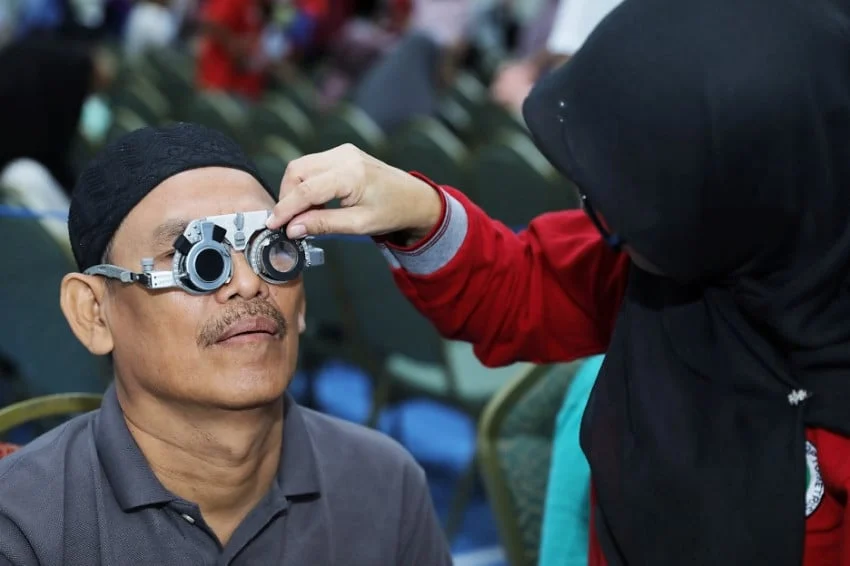
Following the educational briefing, attendees underwent preliminary vision assessments using advanced screening tools, including the EyeCheck system. Trained optometrists and ophthalmology technicians from JEC Eye Hospitals and Clinics evaluated each participant for common refractive errors such as myopia (nearsightedness), hyperopia (farsightedness), and astigmatism. Individuals requiring corrective lenses were immediately directed to an on-site optical dispensary station where they were fitted with free prescription eyeglasses tailored to their specific visual prescriptions. For participants identified as having more complex ocular conditions requiring further medical or surgical intervention, the clinical team provided referral pathways and post-event consultation recommendations.
Addressing the Silent Epidemic of Refractive Errors in Indonesia
The collaboration highlights a pressing public health concern in Indonesia: the high prevalence of uncorrected refractive errors and a general lack of awareness regarding the necessity of regular eye examinations. Refractive errors remain one of the leading causes of visual impairment globally and nationally. When left uncorrected, these conditions impose significant socio-economic and educational burdens, particularly on school-aged children and working adults.
For students, clear vision is a foundational prerequisite for effective learning, academic performance, and cognitive development. Children struggling with uncorrected myopia often experience fatigue, headaches, and diminished comprehension because they cannot clearly see instructional materials presented on boards or in textbooks. Similarly, for educators and laborers within the dhuafa communities, optimal vision is directly linked to occupational productivity, safety, and economic self-sufficiency. Adults experiencing gradual vision loss frequently adapt to their declining sight without realizing that simple corrective interventions can dramatically restore their functional capabilities.
Public Health Insights from Medical Leadership
Highlighting the clinical rationale behind the outreach program, Prof. Tjahjono D. Gondhowiarjo, Senior Director of Development and Education at JEC Eye Hospitals and Clinics, emphasized that public awareness must be paired with tangible service delivery. He noted that refractive errors do not discriminate by age, affecting both pediatric populations and mature adults alike.
According to Prof. Tjahjono, many individuals normalize minor vision changes or remain entirely unaware that their visual acuity has deteriorated over time. This lack of early detection directly impairs learning environments, professional productivity, and general life satisfaction. He underscored that routine eye examinations should not be viewed as an elective luxury, but rather as an essential component of preventative healthcare maintenance. Medical guidelines generally recommend scheduling comprehensive eye evaluations every six months to one year, depending on an individual’s age, pre-existing health conditions, and specific recommendations from qualified ophthalmologists.
Institutional Commitment and Corporate Social Responsibility
As an established leader in specialized eye care across Indonesia with over four decades of operational history, JEC Eye Hospitals and Clinics has consistently prioritized community outreach as a core pillar of its corporate social responsibility strategy. Over the past forty years, the institution has expanded its clinical footprint, advanced specialized ophthalmological technologies, and continuously engaged in public education initiatives to combat avoidable blindness and visual impairment in the country.
The partnership with Syafana Islamic School represents a strategic synergy between private healthcare leadership and educational institutions dedicated to community welfare. By leveraging the school’s community network and JEC’s clinical expertise, the event successfully reached demographic segments that often face economic and logistical barriers to specialized medical facilities. Institutional leaders from Syafana Islamic School expressed deep gratitude for the collaboration, noting that the presence of professional medical teams directly on campus facilitated a seamless and highly impactful outreach experience for both school staff and local residents.
Broader Socio-Economic Implications and Future Outlook
The implications of initiatives such as the JEC and Syafana Islamic School eye examination program extend far beyond the immediate distribution of eyeglasses. By addressing visual impairments within lower-income households and educational environments, such programs generate measurable socio-economic benefits. Restoring clear sight to an educator enhances instructional quality and classroom engagement; providing glasses to a struggling student unlocks academic potential; and equipping a working-age adult with proper vision support improves workplace efficiency and personal safety.
Furthermore, the educational component embedded within the screening program fosters long-term behavioral changes regarding digital screen consumption. In an era dominated by smartphones, tablets, and computers, prolonged digital exposure has contributed to an earlier onset and more rapid progression of myopia, particularly among younger generations. Educating students, teachers, and parents on the importance of balanced screen time, regular visual breaks, and proper ergonomic habits creates a protective buffer against future vision degradation.
Organizers from both JEC Eye Hospitals and Clinics and the PTA Secondary Syafana Islamic School expressed optimism that the success of the October 2026 event will serve as a catalyst for future healthcare collaborations. The initiative successfully demonstrated that cross-sector partnerships between educational communities and specialized medical providers can effectively bridge healthcare disparities at the local level. Moving forward, the stakeholders hope that participants will not only maintain their own ocular health through regular check-ups but also act as advocates within their families and neighborhoods, championing the universal message that clear vision is a vital component of a healthy, productive, and empowered society.