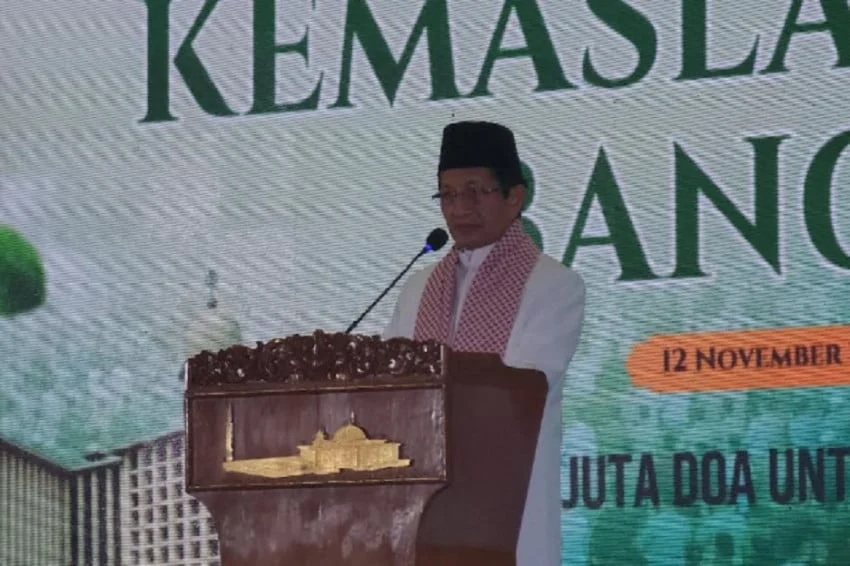
In a profound demonstration of religious harmony and national solidarity, Indonesian Minister of Religious Affairs Nasaruddin Umar convened approximately 100 prominent interfaith leaders at the iconic Istiqlal Mosque in Jakarta. The gathering, held on Thursday, November 12, 2026, served as a platform for constructive dialogue, spiritual reflection, and collective prayer aimed at securing the welfare, peace, and long-term prosperity of the Indonesian nation.
The event transcended conventional diplomatic and administrative boundaries, bringing together representatives from Islam, Christianity, Catholicism, Hinduism, Buddhism, and Confucianism. Set against the backdrop of the country’s diverse socio-cultural landscape, the summit emphasized the indispensable role of interfaith cooperation in navigating contemporary socio-political and economic challenges. Minister Nasaruddin Umar underscored that spiritual unity remains a bedrock of Indonesian statehood, reinforcing the foundational principles of Pancasila and the national motto of Bhinneka Tunggal Ika (Unity in Diversity).
Chronology and Structure of the Interfaith Gathering
The meticulously planned itinerary spanned the afternoon and evening, offering participants a blend of communal worship, intellectual discourse, and spiritual devotion. The proceedings commenced in the late afternoon with the congregational Asr prayer held within the vast
main prayer hall of the Istiqlal Mosque, symbolizing inclusivity and shared sacred space.
Following the initial prayers, the delegation transitioned to the exclusive VIP quarters of the mosque for a high-level interfaith dialogue. Approximately 100 delegates, comprising religious scholars, institutional heads, and grassroots community leaders, engaged in closed-door yet collaborative discussions.
"After that, we moved to another room to conduct an interfaith dialogue. All representatives of various religious communities were present in the VIP room of the Istiqlal Mosque, totaling approximately one hundred people," Minister Nasaruddin stated during his official welcoming remarks.
The dialogue sessions focused on addressing contemporary challenges to social cohesion, mitigating religious polarization, and fostering collaborative frameworks for community welfare. Rather than highlighting theological differences, the discourse concentrated on shared human values, civic responsibility, and the promotion of mutual understanding across diverse faith traditions.
As evening approached, the gathering partook in a communal breaking of the fast, observing the traditional Thursday sunnah (voluntary) fasting practice. This was followed by a rich sequence of spiritual exercises, including dhikr (remembrance of God), collective supplications, mahalul qiyam (standing praises), Quranic recitations, scriptural tafsir (exegesis) studies, and the congregational Maghrib and Isha prayers. The day’s formal proceedings culminated in a grand session of Doa and Munajat for Kemaslahatan Bangsa—a specialized ritual of prayer and intimate supplication dedicated entirely to the peace, safety, and advancement of the Republic of Indonesia.
Contextualizing the Event within Indonesia’s Interfaith Landscape
The selection of the Istiqlal Mosque as the venue for this grand interfaith assembly carries profound symbolic and historical significance. Designed by the Christian architect Frederich Silaban, Istiqlal stands not only as Southeast Asia’s largest mosque but also as a physical monument to religious tolerance. Its proximity to the Jakarta Cathedral, connected famously by the "Tunnel of Friendship," visually reinforces the harmonious coexistence between Indonesia’s Muslim majority and its Christian minority.
In recent years, the Ministry of Religious Affairs under Minister Nasaruddin Umar has placed renewed emphasis on proactive religious diplomacy. Indonesia, home to over 275 million people encompassing hundreds of ethnic groups and numerous recognized religions, faces recurring tests of social tolerance. While the nation boasts a robust tradition of religious moderation, localized tensions, digital misinformation, and political polarization occasionally threaten communal harmony.
By convening leaders from all major officially recognized faiths, the Ministry aims to preemptively fortify social resilience. The timing of the November 2026 gathering coincided with a period of heightened regional and domestic contemplation, overlapping with broader civil society initiatives, such as the various programs organized during the Palestinian Solidarity Month and domestic civic campaigns advocating for national resilience.
Data and Insights on Interfaith Harmony in Indonesia
To contextualize the significance of Minister Nasaruddin’s initiative, it is essential to examine empirical data regarding religious life and social cohesion in Indonesia. According to reports from national statistical agencies and independent research institutes, Indonesia consistently scores moderately high in indices measuring community-level religious tolerance, though challenges persist regarding institutional regulations and localized freedom of worship.
Public policy frameworks in Indonesia have historically relied heavily on traditional and religious figures to maintain peace at the grassroots level. Figures such as the Interfaith Harmony Forum (FKUB)—operating at both provincial and district levels—serve as frontline mediators during disputes concerning places of worship or communal misunderstandings. However, top-down initiatives originating directly from the central government, such as this assembly at Istiqlal, provide crucial moral backing and policy alignment for these local structures.
Sociological studies indicate that top-tier dialogues involving high-ranking government officials significantly boost public confidence in state neutrality and institutional protection of minority rights. When 100 leaders of diverse creeds stand side-by-side inside a national sanctuary to pray for the nation, it projects a powerful image of solidarity that resonates across traditional media and digital platforms alike.
Official Responses and Stakeholder Perspectives
Reactions from participating religious leaders and civil society observers have been overwhelmingly positive. Representatives from the Indonesian Communion of Churches (PGI), the Indonesian Bishops’ Conference (KWI), Parisada Hindu Dharma Indonesia (PHDI), the Indonesian Buddhayana Council (MBI), and the Supreme Council for the Confucian Religion in Indonesia (Matakin) praised the Ministry’s proactive approach.
Speaking on the sidelines of the event, several delegates emphasized that spiritual leaders bear a distinct responsibility to steer their congregations away from divisive rhetoric. In an era dominated by social media algorithms that often amplify extremist views and sensationalized conflict, these leaders stressed the necessity of institutionalizing regular, face-to-face dialogues.
"Prayer is undeniably powerful, but it must be accompanied by active, tangible collaboration on the ground," noted one prominent interfaith representative who attended the closed-door dialogue. "When we break bread, share our concerns, and lift our hands together in prayer, we strip away the "otherness" that political actors or extremists try to manufacture."
Political analysts observing the event noted that the gathering aligns with the broader administrative goals of the current government to maintain macroeconomic and socio-political stability. Economic development, foreign investment, and national resilience heavily depend on internal security and social harmony. By projecting an image of absolute unity among religious leaders, the state effectively mitigates risks associated with identity politics.
Broader Implications and Long-Term Policy Impacts
The implications of the dialogue and prayer event at Istiqlal extend far beyond a single evening of religious observance. The Ministry of Religious Affairs is expected to leverage the momentum generated by this gathering to roll out subsequent community-level programs aimed at strengthening religious moderation (moderasi beragama) across educational curricula, bureaucratic institutions, and local parishes or congregations.
-
Institutionalizing Religious Moderation: The Ministry continues to embed the concept of religious moderation as a core national strategy. Events at Istiqlal serve as high-profile demonstrations of policy in action, translating bureaucratic terminology into visible, living examples of pluralism.
-
Preemptive Conflict Mitigation: By establishing strong interpersonal networks among top religious leaders, the Ministry creates an informal, rapid-response communication channel. In the event of localized religious friction anywhere in the archipelago, these leaders are better positioned to issue joint statements, quell rumors, and deploy grassroots mediation before situations escalate.
-
International Soft Power: Indonesia frequently champions itself as a global model for the harmonious coexistence of Islam, democracy, and modernity. High-profile interfaith assemblies reinforce this diplomatic posture, bolstering Indonesia’s standing in international forums dedicated to human rights, intercultural dialogue, and global peacebuilding.
-
Grassroots Ripple Effects: The challenge for policymakers remains ensuring that top-tier harmony translates to the grassroots level. Analysts suggest that the success of such initiatives will ultimately be measured by how effectively these 100 leaders cascade the messages of tolerance, dialogue, and national welfare down to their respective regional chapters, local clergy, and everyday worshippers.
Conclusion
The gathering of 100 interfaith leaders convened by Minister of Religious Affairs Nasaruddin Umar at the Istiqlal Mosque marks a significant milestone in Indonesia’s ongoing journey to preserve and nurture national unity. By blending rigorous intellectual dialogue with collective spiritual devotion, the event demonstrated that diversity, when met with mutual respect and state-backed facilitation, remains Indonesia’s greatest strategic asset. As the nation confronts complex domestic and international realities, initiatives of this caliber reaffirm that the pursuit of national welfare and spiritual resilience is a shared obligation uniting all citizens, regardless of creed.