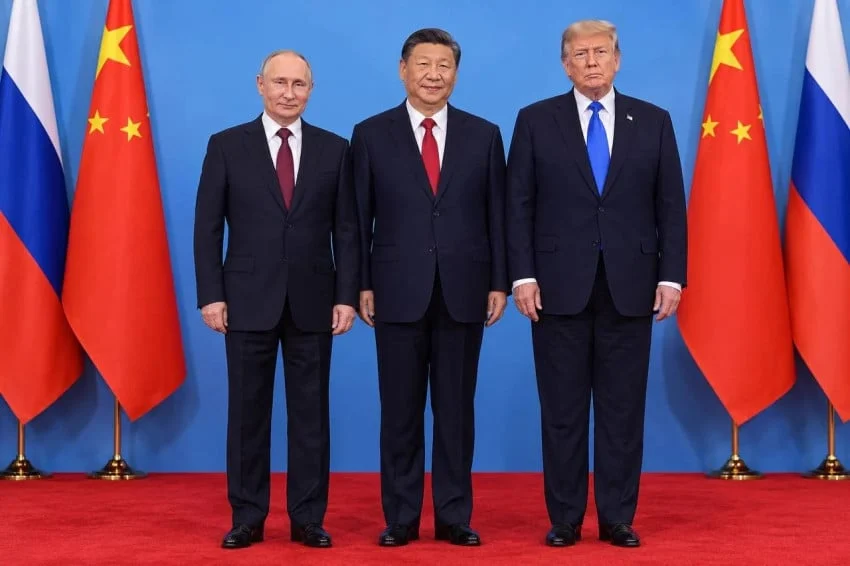
The architecture of international diplomacy shifted dramatically in southern China as the leaders of the United States, China, and Russia convened for a historic, high-stakes trilateral summit. Held away from the traditional multilateral spotlight, a lakeside villa in Shenzhen served as the backdrop for nearly 90 minutes of closed-door negotiations between the world’s three largest nuclear-armed superpowers. The gathering, which took place on the sidelines of the Asia-Pacific Economic Cooperation (APEC) summit, marked the first-ever trilateral meeting of its kind, immediately prompting intense global debate regarding the future configuration of international power and the potential consolidation of an informal "G3" hegemony.
While the summit yielded a four-point "Declaration Toward Peace" addressing critical global concerns, including nuclear risk reduction, United Nations reform, energy supply stability, and sovereign immunity, it has simultaneously triggered profound anxiety among traditional U.S. allies. Policymakers in Europe and Asia are closely scrutinizing whether this elite convergence signals the obsolescence of broader multilateral institutions and the dawn of an asymmetric, great-power condominium that dictates terms to the rest of the international community.
Chronology of the Shenzhen Diplomatic Breakthrough
The path to the historic Shenzhen trilateral meeting was paved by a meticulously orchestrated sequence of bilateral engagements that underscored the shifting dynamics of twenty-first-century statecraft. The chronology of the event highlights the central role played by Beijing in facilitating a dialogue that would have been virtually impossible in any Western or Russian capital due to prevailing geopolitical hostilities.
The diplomatic sequence began days prior to the plenary sessions, marked by extensive preparatory communications between foreign policy apparatuses in Washington, Beijing, and Moskow. On the eve of the trilateral summit, Chinese President Xi Jinping and Russian President Vladimir Putin held a comprehensive bilateral meeting, reinforcing their "no limits" partnership while recalibrating their strategic posture toward the West.
Simultaneously, U.S. President Donald Trump engaged in a separate, highly anticipated 40-minute face-to-face meeting with Putin—their first direct encounter since August 2025. During this encounter, Trump notably referred to the Russian leader as "my friend," signaling a transactional pivot in Washington’s approach to Moscow. Trump also conducted his third bilateral meeting of the year with President Xi, solidifying the personal and diplomatic channels necessary to convene all three leaders under one roof.
The culmination of these efforts occurred on Thursday inside Kylin Villa, a secluded lakeside estate in Shenzhen. For approximately 90 minutes, Xi, Trump, and Putin sat together to negotiate the terms of the four-point declaration. By bringing Washington and Moscow to the same table on Chinese soil, Beijing demonstrated an unmatched capacity to act as a diplomatic nexus, bridging ideological and strategic divides that have paralyzed international bodies like the United Nations Security Council for years.
Core Pillars of the Shenzhen Declaration
The resulting Declaration Toward Peace outlines four specific areas of consensus, reflecting both the pragmatic convergence of interests among the three superpowers and notable omissions that reveal the limits of their cooperation.
-
Non-Proliferation and Nuclear Security: The leaders reaffirmed the foundational tenet that "a nuclear war cannot be won and must never be fought." This reiteration of the Reagan-Gorbachev formulation serves as a stabilizing baseline amidst escalating global tensions, though critics note it lacks enforceable mechanisms for bilateral or trilateral arms control reduction.
-
International Jurisprudence: The declaration takes direct aim at international judicial bodies, explicitly criticizing what the three superpowers characterized as the overreach of the International Criminal Court (ICC). Given that the U.S., China, and Russia are all non-parties to the Rome Statute, this joint stance underscores their shared rejection of external legal accountability for state officials.
-
Energy Infrastructure and Supply: The communique includes a commitment to enhance the production and distribution of refined petroleum products "for the benefit of all nations." This point reflects an implicit recognition by Washington, Beijing, and Moskow of the necessity to stabilize global energy markets, particularly in the face of ongoing supply chain vulnerabilities and economic volatility.
-
Institutional Reform: The leaders touched upon the urgent need for structural reforms within the United Nations to better reflect contemporary global realities, signaling a shared desire to manage international governance frameworks from the top down.
Significantly, the four-point declaration remained entirely silent on several pressing geopolitical flashpoints, most notably the ongoing war in Ukraine and the escalating hostilities between the United States and Iran. Analysts suggest that the omission of these contentious topics was deliberate, designed to prevent immediate deadlocks that could derail the broader diplomatic breakthrough.
The Architecture of Asymmetric Multipolarity
The geopolitical implications of the Shenzhen summit have forced international relations scholars to reevaluate existing models of global order. The concept of "Yalta 2.0"—a direct reference to the 1945 conference where Allied leaders carved out spheres of influence at the conclusion of World War II—has been widely invoked, yet many experts argue it is an inaccurate analog for contemporary realities.
Jianlu Bi, a senior researcher at the think tank Foreign Policy in Focus, offered a nuanced analysis of the emerging global structure during an interview in Shenzhen. Bi characterized the current systemic shift not as a bipolar or unipolar construct, but as a system of "asymmetric multipolarity."
According to this analytical framework, global power is currently distributed unevenly across three distinct domains, each anchored by one of the superpower participants:
- The United States maintains unrivaled global military reach, force projection capabilities, and enduring financial and technological centrality through the dominance of the US dollar and capital markets.
- China commands the definitive center of gravity for global manufacturing, critical mineral refining, and complex supply chain networks, cementing its status as the world’s indispensable economic hub.
- Russia retains substantial geopolitical leverage, nuclear parity, and critical control over vital energy and commodity exports, demonstrating resilience despite sweeping Western economic sanctions.
In this context, Beijing’s role transcends that of a traditional alliance leader. Rather than building a rigid bloc akin to Cold War alignments, China is operating as a "networked stabilizer." As Bi observed, neither Washington nor Moscow could have realistically hosted the other for such high-level bilateral or trilateral talks on their home soil. It was the unique combination of China’s massive economic weight, diplomatic leverage, and secure domestic infrastructure that made the Shenzhen summit possible.
Furthermore, Beijing’s strategic decision to exclude the war in Ukraine from the official text was intended to project a posture of pragmatic mediation rather than imperial coercion. By refusing to formally adjudicate third-party sovereignty issues in a closed trilateral format, China sought to mitigate blowback from European allies and developing nations who remain deeply sensitive to great-power paternalism.
Global Reactions and Strategic Implications for Allies
The emergence of an informal "G3" dynamic has generated considerable apprehension among traditional U.S. allies, particularly within the European Union and the Indo-Pacific region. For decades, Western foreign policy was anchored in transatlantic solidarity and multilateral institutions designed to check the ambitions of authoritarian powers. The sight of an American president sitting alongside the leaders of China and Russia to negotiate global frameworks in a closed-door setting has intensified fears of a condominium model of international governance—where the world’s most powerful nations manage global affairs with little regard for smaller sovereign states.
European capitals have expressed quiet alarm over the lack of consultation regarding issues that directly impact European security architecture, particularly European energy markets and the unresolved conflict in Ukraine. Similarly, key Indo-Pacific partners, including Japan, South Korea, and Australia, are reassessing their long-term strategic calculations as Washington recalibrates its foreign policy toward direct, transactional bargaining with its primary systemic competitors.
Conversely, proponents of realism in international relations argue that the Shenzhen summit represents a necessary, pragmatic acknowledgment of a multipolar reality. In an era defined by existential nuclear risks, economic fragmentation, and transnational challenges, institutional deadlock within the UN Security Council has rendered traditional multilateralism increasingly ineffective. From this perspective, direct, high-level communication channels between Washington, Beijing, and Moskow are not a betrayal of democratic values, but an indispensable mechanism for crisis management and strategic stability.
Fact-Based Outlook: What the Informal G3 Means for the Future
As the international community digests the outcomes of the Shenzhen summit, several long-term implications are becoming clear.
First, the institutional monopoly of Western-led multilateralism is undergoing a permanent structural erosion. While organizations like the United Nations, the World Bank, and the International Monetary Fund will continue to function, their legitimacy and efficacy will increasingly be challenged by informal, great-power arrangements where outcomes are pre-negotiated by the dominant superpowers.
Second, Beijing’s diplomatic triumph in Shenzhen solidifies its ascent as the central node of twenty-first-century global diplomacy. By positioning itself as the indispensable mediator capable of bringing both Washington and Moscow to the table, China has institutionalized its influence over the rules of engagement for major power competition.
Finally, the avoidance of hard security commitments regarding regional conflicts indicates that the informal G3 is currently designed for systemic risk mitigation rather than comprehensive conflict resolution. The primary objective of the Shenzhen framework appears to be the prevention of catastrophic outcomes—such as direct military escalation or uncontrolled nuclear proliferation—rather than the enforcement of a durable, rules-based international order.
Ultimately, whether the Shenzhen summit is viewed as a pragmatic masterstroke of crisis management or the precursor to a partitioned world order, it has irrevocably altered the diplomatic landscape. The future of global governance will no longer be determined by broad consensus among hundreds of sovereign states, but by the ongoing, delicate calculus of three nuclear superpowers navigating an increasingly volatile and interdependent world.