The economic standing of Indonesian agricultural producers experienced a positive shift at the onset of the fourth quarter of 2026, as official figures released by Statistics Indonesia (Badan Pusat Statistik or BPS) revealed a nationwide increase in the Farmers Exchange Rate (Nilai Tukar Petani or NTP). According to the latest monthly statistical update, the national NTP stood at 132.60 in October 2026, marking a 1.13 percent growth compared to the revised figures recorded in September 2026. This vital macroeconomic indicator serves as a primary benchmark for evaluating the financial health, purchasing power, and general welfare of farming households across the archipelago, measuring their ability to cover both household living expenses and agricultural production costs through the commercialization of their yields.
The upward trajectory of the index underscores a favorable economic margin for specific agricultural segments, even as structural challenges persist across different subsectors of the agrarian and maritime economies. The comprehensive data release highlights critical disparities in how inflation, commodity price fluctuations, and operational expenditures impact various rural demographics, providing policymakers, agricultural associations, and economic analysts with a detailed roadmap of the nation’s primary production landscape.
Decoding the Mechanics of the Farmers Exchange Rate
To fully comprehend the significance of the October 2026 NTP data, one must examine the fundamental mechanics governing the index. The Farmers Exchange Rate is calculated as the ratio between the Price Received Index (It)—which tracks the average price levels of agricultural commodities sold by farmers—and the Price Paid Index (Ib)—which monitors the costs of goods and services consumed by farming households, encompassing both household consumption expenses and the purchase of production inputs such as fertilizers, seeds, and equipment. An NTP figure exceeding 100 implies that farmers are experiencing a net improvement in their purchasing power and economic terms of trade, whereas a reading below 100 suggests deteriorating financial conditions.
During the official BPS press briefing held in Jakarta, Ateng Hartono, the Deputy for Distribution and Services Statistics, elaborated on the driving forces behind the October expansion. He noted that the national increase was fundamentally propelled by a sharper growth rate in the prices fetched by farmers compared to the inflation of goods and services they must purchase for daily survival and farming operations.
"The increase in the NTP occurred because the price index received by farmers (It) rose by 1.55 percent, which is significantly higher than the increase in the price index paid by farmers (Ib), which grew by 0.41 percent," Ateng stated during the presentation of the monthly statistical report. This widening positive spread indicates that gross revenue growth outpaced input-cost inflation on a macro scale, offering relief to primary producers who have navigated volatile supply chain dynamics and global commodity price adjustments over recent years.
Commodity Drivers and Subsector Disparities
A deeper dive into the national data reveals that the appreciation of the Price Received Index (It) was not uniformly distributed across all agricultural commodities. BPS identified several key agricultural products that served as the primary growth engines for the overall index. Nationally, dominant commodities contributing to the higher selling prices included natural rubber, corn, red chilies, and unhusked rice (gabah). The resurgence in rubber prices reflects ongoing adjustments in global industrial demand, while staple crops like corn and unhusked rice continue to receive steady domestic support underpinned by national food security programs.
When disaggregated by agricultural subsectors, the NTP performance in October 2026 revealed a bifurcated landscape. Positive gains were heavily concentrated in the food crops, horticulture, and smallholder plantation subsectors, whereas the animal husbandry (livestock) and fisheries sectors contracted.
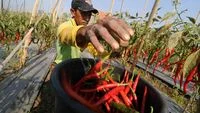
The horticulture subsector emerged as the star performer of the month, recording a dramatic NTP surge of 6.88 percent. This robust expansion was primarily catalyzed by a steep 7.12 percent jump in the price index received by horticultural producers, contrasted against a very modest 0.23 percent increase in the price index paid by these same farmers. The dominant market catalysts fueling this horticultural rally were sharp price appreciations in volatile food commodities, specifically red chilies, fresh tomatoes, and bird’s eye chilies (cabai rawit). Horticultural products are historically prone to acute monthly price volatility driven by localized weather patterns, regional harvest cycles, and distribution bottlenecks, making October a particularly lucrative period for vegetable and fruit cultivators.
Conversely, the livestock and fisheries subsectors moved in the opposite direction. The NTP for animal husbandry dropped by 0.88 percent, while the fisheries subsector experienced a 0.51 percent contraction. BPS data indicated that the downturn in the fisheries sector was largely dragged down by a weakening Fishermen Exchange Rate (Nilai Tukar Nelayan or NTN), which fell by 0.99 percent. Interestingly, the sub-segment of fish cultivators (aquaculture) managed to buck the broader maritime trend, recording a modest NTP increase (NTPI) of 0.26 percent.
Detailing the downward pressure on marine fishers, Ateng explained that the decline in the NTN stemmed from a combination of falling catch revenues and rising operational overheads. "The decline in the fishermen’s exchange rate is primarily because the price index received by fishermen dropped by 0.51 percent, while the price index paid by fishermen increased by 0.49 percent," he remarked. The primary aquatic commodities responsible for eroding the selling prices received by marine fishers included skipjack tuna (cakalang), coastal scad mackerel (layang), and eastern little tuna (tongkol). These downward price adjustments for staple marine catches highlight the persistent vulnerability of traditional fishers to coastal supply fluctuations, seasonal weather changes, and localized market gluts.
Background Context and Historical Chronology
The October 2026 statistical release arrives against the backdrop of sustained efforts by the Indonesian government to stabilize domestic food prices while protecting producer margins. Throughout late 2024 and 2025, the agricultural sector faced intense pressures from global geopolitical tensions, fluctuating fertilizer subsidies, and extreme weather phenomena associated with climate variability, including prolonged dry spells that periodically disrupted planting and harvesting schedules.
In response, the Ministry of Agriculture, in coordination with regional administrations and logistics agencies, implemented targeted interventions focused on strengthening agricultural supply chains, improving distribution efficiency, and expanding access to subsidized production inputs. By mid-2026, weather patterns had largely normalized across major agricultural heartlands in Java, Sumatra, and Sulawesi, allowing for steady harvests of staple food crops and horticultural commodities.
The chronological progression of the NTP throughout the third quarter of 2026 demonstrated gradual stabilization. Following modest fluctuations through July and August, September 2026 established a solid baseline, which paved the way for the 1.13 percent expansion recorded in October. This positive momentum is viewed by agricultural economists as a crucial seasonal buffer, especially as the nation prepares for the transition into the rainy season, which typically brings both agricultural rejuvenation and logistical challenges.
Implications and Policy Responses
The mixed findings of the October 2026 BPS report carry significant implications for national economic policy, rural development strategies, and targeted welfare interventions. While the overall rise in the NTP signals improved financial viability for millions of farmers engaged in food crops, plantations, and horticulture, the simultaneous contraction in the livestock and fisheries sectors demands nuanced, sector-specific policy adjustments.
Agricultural economists and industry observers have pointed out that while higher crop and horticultural prices boost producer incomes, they also feed into broader consumer price index (CPI) inflation, presenting a delicate balancing act for monetary authorities and food stabilization agencies. Ensuring that farmers capture fair margins without triggering inflationary spikes for urban consumers remains a core challenge for national economic management.
Furthermore, the persistent decline in the Fishermen Exchange Rate underscores the urgent need for structural interventions in the maritime economy. Independent analysts and fishing industry associations have frequently called for enhanced fuel subsidies tailored to traditional fishers, improved cold-chain infrastructure to prevent post-harvest price depreciation during peak catch seasons, and expanded access to modern navigation and fish-finding technology. Without such measures, marine fishers risk falling further behind their land-based agricultural counterparts in terms of purchasing power and long-term economic resilience.
In light of the October data, agricultural policy analysts anticipate that the government will likely intensify its focus on regional supply chain optimization, particularly for volatile horticultural commodities where sudden price spikes can destabilize household expenditures. At the same time, subsidy distribution mechanisms for livestock feed and marine diesel are expected to face renewed scrutiny to ensure that operational cost pressures (Ib) are effectively mitigated for vulnerable producers.
As Indonesia navigates the final quarter of 2026, the ongoing tracking of the Farmers Exchange Rate will remain a cornerstone metric for assessing the tangible outcomes of national food and agrarian policies. The ability of policymakers to address the specific vulnerabilities highlighted in the livestock and fisheries sectors, while sustaining the positive momentum in crops and horticulture, will dictate the trajectory of rural welfare in the months ahead.