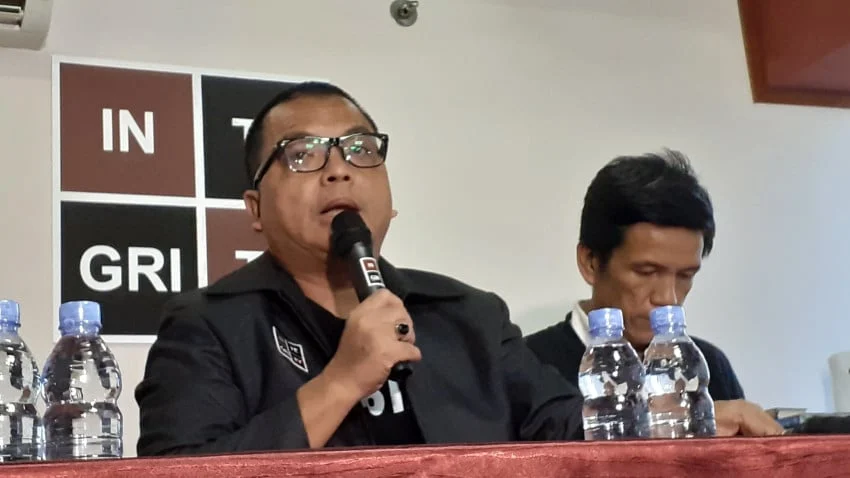
The political landscape in Indonesia has reached a critical juncture following a bold assertion by constitutional law expert Denny Indrayana, who formally proposed that the House of Representatives (DPR RI) initiate the Right to Express Opinion (Hak Menyatakan Pendapat or HMP) to pursue the impeachment of Vice President Gibran Rakabuming Raka. Speaking from the Integrity Law Firm in Central Jakarta on Monday, November 2, 2026, Indrayana argued that the legislative body possesses an unambiguous legal foundation to proceed with the constitutional mechanism, citing recent rulings from both the Constitutional Court (MK) and the Supreme Court (MA).
The Legal Basis for Constitutional Action
The core of Indrayana’s argument rests on the assertion that the Vice President does not fulfill the mandatory educational qualifications stipulated under the national Election Law. According to Indrayana, the synchronization of recent judicial rulings has created a clear path for the DPR to exercise its oversight function. "I am of the opinion that with the existence of the Constitutional Court and Supreme Court rulings—which are clear, aligned, and consistent in asserting that Gibran does not meet the educational requirements—the DPR should immediately exercise its right to express an opinion," Indrayana stated.
This call for action invokes Article 7A of the 1945 Constitution of the Republic of Indonesia. This constitutional provision outlines the grounds upon which a President or Vice President may be impeached, specifically if they are proven to have committed a violation of the law in the form of treason, corruption, bribery, other grave crimes, or shameful acts, or if they are no longer deemed to meet the requirements to serve as President or Vice President. Indrayana contends that the failure to meet the statutory educational threshold falls squarely within the category of not meeting the requisite qualifications for office.
Chronology and Judicial Context
The current situation is the culmination of a long-standing debate regarding the eligibility of Gibran Rakabuming Raka, which began during the lead-up to the 2024 General Elections. The controversy initially centered on the age limit requirements and the subsequent debate over the authenticity and adequacy of academic credentials.
Throughout 2025 and into 2026, various legal challenges were filed by civil society groups and political observers. These challenges sought to clarify whether the credentials presented by the Vice President satisfied the rigorous standards demanded of a head of state under Indonesian law. The recent rulings by the Supreme Court and the Constitutional Court, as referenced by Indrayana, appear to have shifted the discourse from a political debate to a formal legal matter.
The timeline of these legal developments suggests that the judiciary has moved toward a more restrictive interpretation of candidate eligibility. For the DPR, this transition from judicial opinion to a potential legislative impeachment process marks a significant escalation in the tensions between the executive and legislative branches of government.
Political Implications and the Role of the DPR
The push for impeachment is not merely a legal maneuver but a high-stakes political strategy. In a democratic system, the HMP is a powerful tool. Under the Law on the People’s Consultative Assembly, House of Representatives, and Regional Representative Council (MD3 Law), the HMP is the final stage of the DPR’s oversight rights. It requires a plenary session where a majority of members must agree to the motion.
Political analysts have noted that the success of such an initiative depends entirely on the coalition dynamics within the House. Currently, the ruling coalition supporting President Prabowo Subianto holds a significant majority. However, figures like political observer Ray Rangkuti have publicly urged the four political parties within the coalition to take the lead in this process, suggesting that there may be fractures within the ruling bloc regarding the continued viability of the current Vice President.
If the DPR were to move forward, it would trigger a formal inquiry process, potentially involving the Constitutional Court to verify the evidence of the "failure to meet requirements." This would be a protracted process that could paralyze government operations, leading to significant market uncertainty and public unrest.

Analyzing the Constitutional Threshold
From a strictly constitutional standpoint, the impeachment of a sitting Vice President is an extraordinary event that the framers of the 1945 Constitution intended to be difficult to execute. The Article 7A requirement of "no longer meeting the requirements" is an objective standard, but its application is inherently political.
Legal experts argue that while the court rulings provide the necessary evidentiary "hook," the DPR must prove that the lack of educational qualifications—if validated—constitutes a breach so severe that it undermines the legitimacy of the entire administration. There is a distinction between a technical administrative error and a disqualifying factor. The burden of proof lies with the House to demonstrate that the Vice President’s tenure is fundamentally unconstitutional.
Reactions from the Political Establishment
The response from the government and allied political parties has been largely cautious. Many spokespersons for the ruling coalition have dismissed the calls for impeachment as premature or politically motivated. They argue that the judiciary’s role is to interpret the law, but the removal of a constitutional officer must remain within the bounds of stability and national interest.
Meanwhile, opposition parties have adopted a "wait and see" approach. While some have expressed interest in the legal merits of Indrayana’s argument, there is widespread concern regarding the potential for systemic instability. The Indonesian economy, which has been focused on post-pandemic recovery and infrastructure development, is sensitive to political shocks. An impeachment proceeding would likely cause a dip in investor confidence and complicate the legislative agenda for the remainder of the term.
Broader Societal Impact
The discourse surrounding the Vice President’s eligibility has sparked significant public debate. Social media and civil society forums have become arenas for intense discussion about the integrity of the electoral process and the importance of academic transparency for high-ranking officials.
For the general public, the primary concern remains the continuity of governance. Many citizens are wary of the instability that would follow an impeachment, while others feel that upholding the rule of law—regardless of the political cost—is essential to the long-term health of Indonesia’s democracy. The challenge for the DPR is to balance these competing interests while navigating a constitutional framework that is rarely tested in such a manner.
Future Outlook and Next Steps
As the DPR prepares for its next session, the pressure to address or officially dismiss the calls for impeachment will mount. The formal invocation of the Right to Express Opinion would require the DPR to form a special committee to investigate the claims. This committee would then report back to the plenary session, where a vote would determine whether to proceed with a formal impeachment motion to the Constitutional Court.
The coming weeks will be critical. If the political parties perceive that the Supreme Court and Constitutional Court rulings have indeed created a "point of no return" regarding the Vice President’s legitimacy, the likelihood of a formal HMP motion increases. However, if the coalition remains unified, the motion may be relegated to the legislative archives, potentially simmering as a point of contention until the next general election cycle.
Ultimately, the situation underscores the evolving nature of Indonesian constitutional law. The intersection of judicial oversight and legislative authority is being tested in real-time. Whether the DPR chooses to exercise its constitutional powers or opt for a political compromise will define the trajectory of the current administration and the strength of the nation’s democratic institutions. The judiciary has provided the findings; the legislature now holds the gavel.