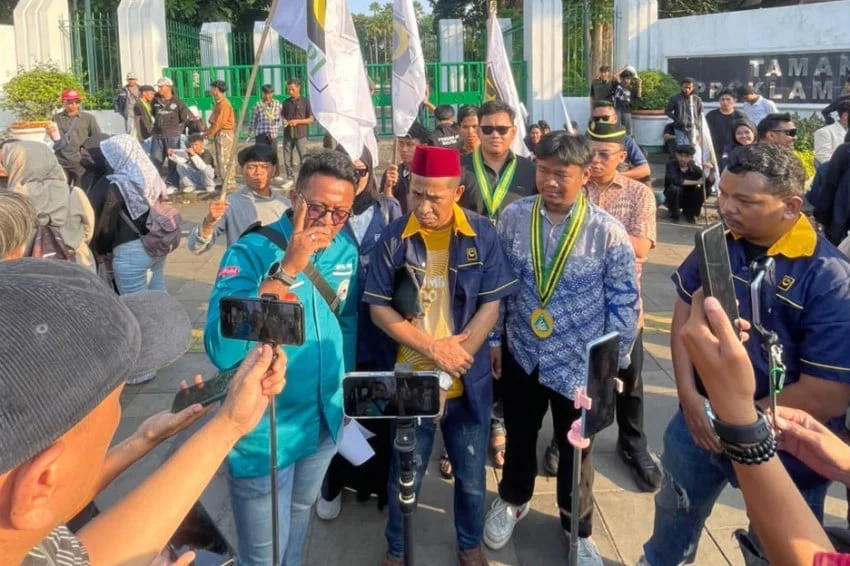
In a significant display of public accountability and institutional reform, three prominent national youth and student organizations—the Central Leadership of the Islamic Youth Movement (PP GPI), the Executive Board of the Indonesian Islamic Student Association (PB PII), and the Central Board of the Aliansi Mahasiswa Muslim Maluku Kie Raha (DPP AL-MULK)—have formally expressed their high appreciation for the swift intervention of the Chief of the Indonesian National Police (Kapolri), General Suyudi Ario Seto. This commendation stems from the National Police’s decisive handling of a controversial raid conducted at the Hamalatul Quran Islamic Boarding School in Sukoharjo, Central Java.
The official statement was delivered by the leadership of these organizations at the historic grounds of the Tugu Proklamasi in Central Jakarta on Tuesday, November 3, 2026. The coalition highlighted that the Kapolri’s immediate decision to relieve the Sukoharjo Police Chief of his duties represents a pivotal moment in restoring public trust and upholding the principles of professional law enforcement in Indonesia.
Chronology of the Sukoharjo Incident
The controversy began when law enforcement units conducted a raid on the Hamalatul Quran Islamic Boarding School in Sukoharjo. The operation quickly drew widespread criticism from local communities, religious leaders, and educational advocates who questioned the necessity and the tactical approach employed during the search. Concerns were raised regarding the potential violation of standard operating procedures (SOPs) and the lack of sensitivity toward an educational environment.
Following the circulation of reports regarding the conduct of the officers during the operation, public outcry intensified. The incident became a focal point for debates regarding the balance between security operations and the protection of civil liberties, particularly within religious institutions. Within 48 hours of the incident gaining national media attention, the Kapolri intervened directly. By ordering an immediate investigation and the subsequent removal of the Sukoharjo Police Chief, General Suyudi Ario Seto signaled that the National Police leadership would not tolerate deviations from professional standards.
The Significance of the Joint Statement
Speaking at the Tugu Proklamasi, Khoirul Amin, the General Chairman of PP GPI, emphasized that the actions taken by the National Police leadership were a necessary response to public demands for transparency. "This is not merely about a change in personnel; it is a clear signal that reform within the Polri (Indonesian National Police) is an ongoing process aimed at maintaining professional integrity," Amin stated. He noted that the speed at which the Kapolri responded to the grievances of the Muslim community served as a positive indicator of the police’s willingness to engage in self-correction.
For their part, Amsal Alfian (General Chairman of PB PII) and Fauzan Ohorela (General Chairman of DPP AL-MULK) underscored the importance of a transparent and open investigation. In their address to the media, both leaders argued that the legal process must be handled with humanistic care, especially when dealing with educational and religious entities. "We demand that the investigation into the Sukoharjo raid be carried out without prejudice. The public deserves to know the findings of the internal investigation, and justice must be served fairly, without regard to rank or position," said Alfian.
Broader Implications for Indonesian Law Enforcement
The case in Sukoharjo has become a litmus test for the "Presisi" (Predictive, Responsible, and Transparent) policy currently advocated by the National Police headquarters. Observers suggest that the rapid response to the Sukoharjo incident is part of a broader strategy to mitigate tensions between law enforcement and local communities.
Data from the Indonesian Ombudsman and other civil society watchdogs indicate that over the past few years, there has been a steady increase in public expectations for police accountability. The ability of the police to respond to internal lapses—specifically regarding the conduct of regional police commands—is seen as essential to maintaining the legitimacy of the state’s security apparatus. By proactively removing a regional leader, the National Police is attempting to insulate the institution from accusations of systemic bias or lack of oversight.
The Role of Youth and Student Coalitions
The involvement of PP GPI, PB PII, and DPP AL-MULK highlights the growing role of organized student and youth groups in holding government institutions accountable. These organizations, which possess large networks across the archipelago, serve as conduits for community feedback. Their endorsement of the Kapolri’s actions serves a dual purpose: it legitimizes the police’s corrective measures while simultaneously placing the institution under a watchful public eye.
The coalition emphasized that while they support the current corrective measures, their support is conditional on the successful and transparent completion of the ongoing investigation. The groups have vowed to continue monitoring the situation to ensure that the investigation does not stall once the initial media attention subsides.
Strengthening Institutional Trust
The policy of "transparent investigation" as promised by General Suyudi Ario Seto is intended to rebuild the relationship between the police and the citizenry. In the context of the Sukoharjo incident, the primary objective is to reassure the public that educational facilities are protected and that law enforcement operations will adhere to the rule of law.
Legal experts suggest that the "Sukoharjo precedent" may influence future operations. If the investigation concludes with a comprehensive public report detailing the failures of the raid and the subsequent disciplinary actions taken, it could set a new standard for how the National Police manages controversial cases. This would involve:
- Direct Oversight: Continued involvement of the National Police headquarters in cases that threaten public trust.
- Public Disclosure: Greater transparency regarding the results of internal disciplinary hearings (Propam).
- Community Engagement: Enhanced dialogue between local police units and the communities they serve to prevent escalations during investigations.
Looking Ahead: Expectations for Justice
As the investigation into the Sukoharjo raid continues, the focus will shift toward the specific findings of the internal police tribunal. The coalition of youth groups has indicated that they expect the investigation to move beyond the removal of the police chief to address the root causes of the operation’s conduct.
The sentiment expressed at Tugu Proklamasi was clear: the actions of the Kapolri are a welcomed step, but the final verdict will rest on the outcome of the comprehensive investigation. For the Indonesian National Police, this incident is a critical opportunity to demonstrate that the institution is committed to the values of justice, equality, and human rights.
General Suyudi Ario Seto has effectively utilized the Sukoharjo incident to demonstrate that the hierarchy of the National Police is responsive to public sentiment. However, the true test will be whether this responsiveness leads to long-term structural changes that prevent similar incidents from occurring in the future. As Indonesia navigates complex socio-political dynamics, the ability of its police force to operate with both authority and humility will remain a cornerstone of national stability.
Conclusion
The collaborative efforts of PP GPI, PB PII, and DPP AL-MULK in publicly acknowledging the Kapolri’s decisive action reflect a healthy civic discourse in Indonesia. By engaging in constructive criticism and supporting positive institutional change, these organizations are playing a vital role in the evolution of Indonesia’s democratic landscape.
The Sukoharjo raid, while initially a source of conflict, has provided a platform for a necessary conversation about the boundaries of law enforcement and the expectations of the public. With the Kapolri’s commitment to transparency, all eyes remain on the National Police as they navigate this sensitive process, with the hope that it will result in a more professional, accountable, and trusted institution for all Indonesians. The events of November 3, 2026, serve as a reminder that in a functioning democracy, the relationship between the state and its citizens is defined by mutual respect, accountability, and the shared pursuit of justice.