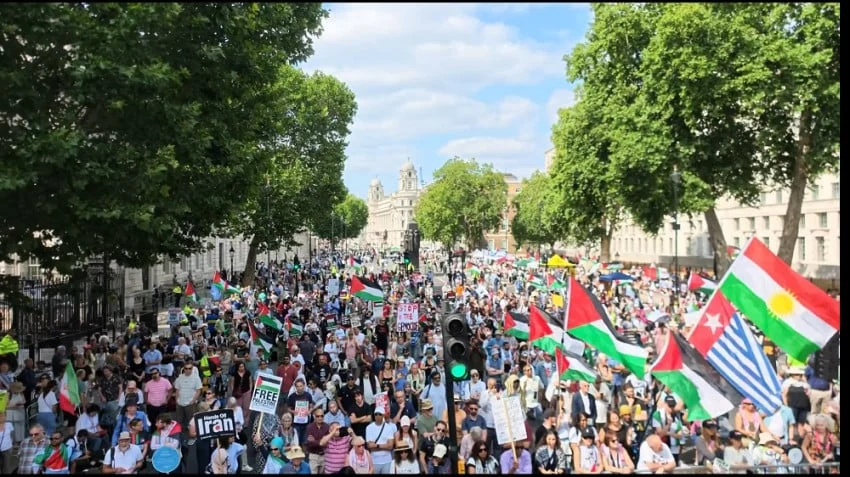
Tens of thousands of young people, students, and workers flooded the streets across more than 25 European countries in a coordinated international day of action that highlights a profound and widening generational disconnect. The demonstrations, spearheaded largely by Generation Z activists, brought normal daily operations to a halt in major metropolitan areas including London, Paris, Madrid, Rome, and Berlin. This sweeping wave of civil unrest is not driven by a single isolated grievance, but rather by an accumulation of systemic pressures. Protesters are voicing intense frustration over soaring costs of living, skyrocketing tuition fees, chronically underfunded public education systems, high youth unemployment, and the escalating climate crisis. Furthermore, the mobilization has taken on a strong geopolitical dimension, with participants fiercely condemning what they characterize as European leadership’s complicity in the ongoing Israel-Hamas conflict in Gaza.
The widespread protests signal a pivotal moment for Europe’s youngest politically active demographic. Long accused of political apathy, Gen Z is demonstrating a high degree of transnational organization, utilizing digital platforms to synchronize efforts across borders. As governments grapple with post-pandemic economic recovery, persistent inflation, and technological disruption, the demands pouring out of Europe’s public squares present a formidable challenge to the continent’s established political order.
Chronology and Escalation of the Autumn 2024 Mobilizations
The seeds of this transnational mobilization were sown months prior, as various student unions, climate action groups, and labor organizations began documenting converging crises affecting young Europeans. Throughout late summer and early autumn, localized student walkouts and university occupations took place in several Western European nations, particularly in the United Kingdom and France, where tuition costs and housing shortages have reached critical thresholds.
By early October, digital coordination among youth networks across the European Union, the United Kingdom, and neighboring regions culminated in a call for a synchronized continental day of action. Organizers strategically targeted Friday to maximize economic disruption and secure prominent media coverage as the workweek concluded.
In Italy, the movement gained significant institutional muscle when major labor unions, notably the Italian General Confederation of Labour (CGIL), threw their weight behind the youth-led initiative. The convergence of student grievances and labor demands transformed what might have been isolated demonstrations into a massive nationwide strike. By Friday morning, protesters had occupied central squares in more than 100 Italian cities, including a dense gathering at the historic Piazza del Duomo in Milan. Simultaneously, transportation strikes crippled rail networks and urban transit systems, underscoring the deep economic leverage wielded by the coalition of workers and youth.
Concurrently, in the United Kingdom, student groups marched toward government offices in London, demanding emergency intervention in the higher education sector. In France and Spain, similar scenes played out as demonstrators blocked thoroughfares, calling for sweeping reforms to labor laws and housing markets that have increasingly marginalized young citizens attempting to enter the workforce.
Core Grievances: A Multidimensional Crisis Facing the Younger Generation
The grievances fueling these demonstrations are deeply interconnected, forming a complex web of socioeconomic and political anxieties that disproportionately affect individuals aged 18 to 27.
First and foremost is the punishing cost-of-living crisis. Years of post-pandemic inflation, compounded by energy market instability following geopolitical conflicts, have left young Europeans facing exorbitant rent, utility, and food prices. For entry-level workers and university students living independently, the financial math no longer works. Many find themselves trapped in precarious gig-economy jobs with little job security, stagnant wages, and zero prospect of homeownership.
Second, higher education has become a battleground. In countries like the UK, where tuition fees remain exceptionally high, students argue they are paying premium prices for degraded educational experiences. Crowded lecture halls, overstretched faculty, and crumbling campus infrastructure are cited as symptoms of systematic underfunding. In mainland Europe, where public education has historically been more accessible, hidden costs such as mandatory student housing fees, textbook inflation, and administrative charges have created formidable financial barriers.
Third, the existential threat of climate change remains a foundational pillar of Gen Z activism. Despite years of youth-led climate strikes epitomized by the Fridays for Future movement, young demonstrators argue that European governments are backpedaling on green transition targets to appease short-term economic interests. They view current environmental policies as entirely inadequate to prevent catastrophic global warming, effectively mortgaging their livable future for political expediency.
Fourth, the rapid, unregulated advancement of Artificial Intelligence (AI) has emerged as a novel source of profound anxiety. Unlike older generations who view AI primarily through the lens of productivity and economic growth, Gen Z enters the workforce acutely aware that automation threatens entry-level white-collar jobs, creative industries, and administrative positions. Protesters are demanding proactive regulatory frameworks from Brussels and national capitals to protect future employment markets from chaotic technological disruption.
Finally, the protests have been heavily galvanized by international policy, particularly regarding the Middle East. Across university campuses and city streets, demonstrators have vocally criticized European Union foreign policy concerning the conflict in Gaza. Chanting slogans and waving Palestinian flags, participants accused their governments of hypocrisy—advocating for human rights abroad while actively supporting or failing to condemn military actions that have resulted in massive civilian casualties. This intersection of domestic socioeconomic struggles with global human rights concerns highlights a generation that views local and international politics as inseparable.
Socioeconomic Data and the Structural Plight of European Youth
The anger expressed in the streets is firmly rooted in statistical reality. According to recent Eurostat data, the youth unemployment rate across the European Union remains stubbornly high, averaging nearly 15%, with severe spikes exceeding 25% in Southern European nations like Spain and Greece. Even for those fortunate enough to secure employment, underemployment and low-wage contracts are rampant.
Furthermore, housing market indicators paint a grim picture for Europe’s youth. Real estate prices and rental rates have outpaced wage growth exponentially over the past decade. A substantial percentage of young adults in Western Europe are now forced to remain living with their parents well into their late twenties—not out of cultural preference, but out of absolute economic necessity.
In the educational sector, budget allocations have failed to keep pace with inflation and surging student enrollment numbers. Public universities across the continent report severe resource constraints, forcing administrators to increase class sizes while cutting specialized programs. The intersection of high debt—where tuition fees apply—and low starting salaries has created a demographic cohort that feels economically disenfranchised before their careers have even properly begun.
Official Responses and Institutional Reactions
As tens of thousands of demonstrators disrupted public infrastructure and filled civic spaces, responses from national governments and institutional leaders varied from cautious acknowledgment to defensive pushback.
In the United Kingdom, government spokespersons acknowledged the financial pressures facing students and young workers, pointing to ongoing efforts to stabilize the economy and reform rental markets. However, officials declined to entertain demands for immediate tuition fee abolitions, citing stringent fiscal constraints.
In Italy, where the involvement of trade unions amplified the disruption, conservative political figures criticized the strikes for exacerbating economic difficulties and causing unnecessary inconvenience to commuters. Conversely, center-left and progressive opposition lawmakers visited the protest sites, utilizing the momentum to criticize the ruling administration’s handling of public spending, healthcare, and education.
European Union officials in Brussels watched the coordinated actions with mounting concern. While EU leadership has consistently championed youth initiatives—such as the European Year of Youth and various employment guarantee schemes—critics within the protest movement argue these programs amount to little more than bureaucratic window dressing that fails to address structural inequities.
Broader Implications and Long-Term Political Fallout
The mass mobilization across 25 European nations carries significant long-term implications for the political landscape of the continent.
Politically, these protests illustrate a growing disillusionment with traditional political parties. Many young activists feel abandoned by both center-left and center-right establishments, driving them either toward radical political alternatives or into deep political cynicism. If mainstream governments fail to channel these grievances into tangible policy reforms, the risk of sustained social unrest and deep-seated political polarization will intensify.
Economically, the disruption caused by nationwide strikes in countries like Italy demonstrates the systemic leverage that a coalition of youth and labor can exert. As demographic shifts leave Europe with aging populations and shrinking domestic workforces, alienating the younger generation carries severe economic risks. Without urgent reforms to housing affordability, wage structures, and educational funding, European economies risk severe brain drain and deepening productivity stagnation.
Ultimately, the coordinated European protests of autumn 2024 serve as a loud, unmistakable warning shot to the continent’s leaders. Generation Z has proven capable of organizing across borders and demanding systemic change with a unified voice. Whether European institutions possess the political will and fiscal flexibility to meet these demands remains the defining question for the region’s political future.