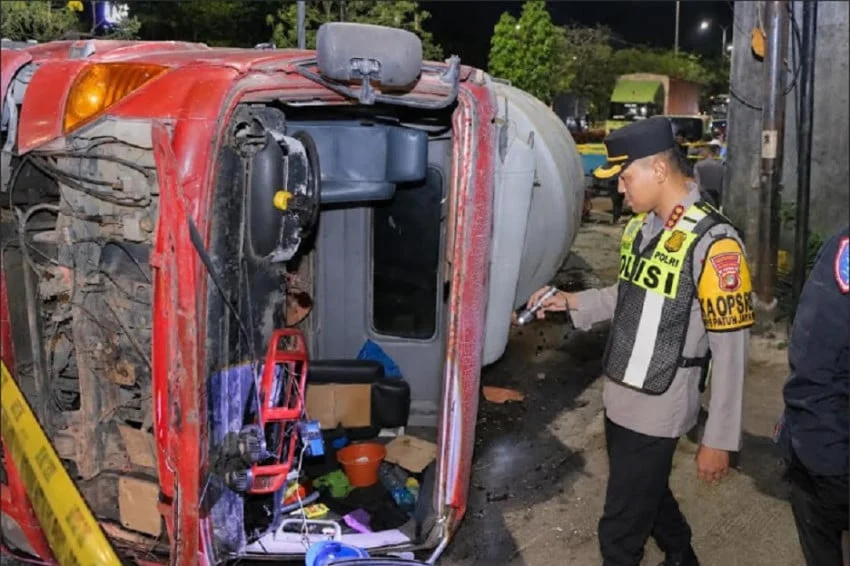
The serenity of a Sunday afternoon in the Rawalumbu district of Bekasi, West Java, was shattered on November 1, 2026, when a massive concrete mixer truck careened out of control, plowed into a crowd of pedestrians, and ultimately overturned. The catastrophic incident, which occurred on the busy thoroughfare of Jalan Cut Mutia, resulted in six fatalities and left six others with serious injuries. Following an immediate investigation by the Polres Metro Bekasi Kota, the driver of the heavy vehicle, identified by the initials TM, was apprehended and taken into custody as authorities began a rigorous examination into the mechanical and human factors that precipitated the tragedy.
Chronology of the Incident
The incident unfolded during the late afternoon on Sunday, November 1, 2026. According to preliminary reports gathered by traffic investigators, the concrete mixer truck was navigating the Jalan Cut Mutia corridor when it reportedly suffered a catastrophic brake failure. Witnesses in the vicinity described a scene of chaos as the vehicle began to pick up speed uncontrollably, eventually veering off the main road and colliding with a group of people gathered near the roadside in the Kelurahan Sepanjang Jaya area of Rawalumbu.
The impact was severe, causing the heavy vehicle to topple over, trapping individuals beneath the wreckage. Emergency services were alerted immediately, leading to a frantic rescue operation that spanned several hours. Medical personnel and local residents worked in tandem to extract the victims and transport them to nearby hospitals. Despite these efforts, the severity of the impact proved fatal for six individuals at the scene, while the remaining six injured parties were rushed to local healthcare facilities for emergency stabilization.
Immediate Police Response and Forensic Investigation
By Monday morning, November 2, 2026, the investigation was already well underway. Kapolres Metro Bekasi Kota, Kombes Pol Putu Kholis Aryana, confirmed that the driver, TM, had been secured and the heavy vehicle impounded as a primary piece of evidence. The police have initiated a multi-pronged investigative approach to establish a definitive timeline and cause for the brake failure.
“The Gakkum (Law Enforcement) Unit of the Satlantas Polres Metro Bekasi Kota has apprehended the suspected driver, TM, and has secured the concrete mixer truck as evidence,” stated Kombes Pol Putu Kholis Aryana. He emphasized that the investigation is not merely relying on eyewitness accounts but is being supported by forensic evidence gathered from the scene. The police have processed the site through extensive documentation, collected statements from surviving witnesses, and performed a comprehensive review of CCTV footage from the surrounding area to track the vehicle’s path leading up to the collision.
To further ensure the accuracy of the investigation, the police have enlisted the expertise of the Traffic Accident Analysis (TAA) team from the Ditlantas Polda Metro Jaya. This specialized unit is scheduled to perform a scientific reconstruction of the accident on Monday. This process involves using 3D scanning, skid mark analysis, and vehicle telemetry checks to determine the exact speed and mechanical state of the truck at the moment of the incident.
The Role of Scientific Crime Investigation
The approach taken by the Bekasi Police reflects a modern shift toward "scientific crime investigation" in Indonesia. Rather than relying solely on subjective testimonies, the authorities are prioritizing empirical data. Kombes Pol Putu Kholis Aryana has committed to full transparency throughout this process.
“This tragedy will be investigated thoroughly and transparently through the lens of scientific crime investigation. Every decision made by this department will be rooted in the facts that are revealed during the analysis, which serves as a vital component of our responsibility to the victims’ families and the public at large,” he noted. The status of the driver will be formalized following the conclusion of the TAA report and the completion of the formal investigative dossier.
Safety Concerns and Infrastructure Context
The accident on Jalan Cut Mutia has reignited a long-standing debate regarding the safety of heavy vehicle traffic in densely populated urban corridors. Bekasi, a satellite city of Jakarta, is a major industrial hub with a high volume of logistical traffic. The presence of large concrete mixer trucks—often referred to locally as "truk molen"—on public roads alongside pedestrians and private vehicles has long been a point of contention among urban planners and safety advocates.
Data from the Ministry of Transportation suggests that mechanical failure remains a leading cause of heavy-vehicle accidents in Indonesia. Factors such as lack of routine maintenance, overloading of heavy machinery, and the wear and tear of driving in stop-and-go urban traffic are frequently cited as contributing elements. While it is premature to determine the exact technical failure in this specific case, the incident serves as a grim reminder of the risks posed by large industrial vehicles operating in proximity to high-pedestrian-traffic zones.
Broader Implications for Urban Traffic Management
The tragedy in Rawalumbu is likely to trigger a review of traffic regulations concerning the transit times and routes for heavy machinery in Bekasi. Urban safety experts have argued that the city’s rapid development has outpaced its traffic management infrastructure, leading to a dangerous mix of logistics and residential life.
There are growing calls for local government authorities to implement stricter "window hours" for heavy vehicles, restricting them from passing through major residential arteries during peak hours or busy weekend afternoons. Furthermore, the incident highlights the need for better vehicle inspection regimes (KIR tests) to ensure that companies operating heavy fleets are held strictly accountable for the mechanical integrity of their vehicles.
The Human Cost and Community Impact
The loss of six lives has sent shockwaves through the local community. The Rawalumbu area, known for its busy markets and residential density, has been forced to confront the vulnerability of its public spaces. Local community leaders have begun organizing support for the families of the deceased, calling for swift justice and accountability from both the driver and the company responsible for the vehicle.
The legal process moving forward will likely focus on whether the mechanical failure was a result of negligence—such as missed maintenance schedules or operator error—or a sudden, unforeseeable equipment failure. Under Indonesian traffic laws, if negligence is proven, the driver could face charges under the Law on Road Traffic and Transportation, which carries significant prison sentences for accidents resulting in fatalities.
Moving Toward Resolution
As the TAA team prepares to conduct its scientific reconstruction, the public and the victims’ families are waiting for definitive answers. The commitment from the Polres Metro Bekasi Kota to provide a transparent, evidence-based report is intended to mitigate the social tension that often follows such high-profile tragedies.
For the city of Bekasi, this event is a stark call to action regarding infrastructure safety and the regulation of industrial transit. As the investigation progresses, the focus will remain on the intersection of technical culpability and the broader policy changes required to prevent a recurrence of such a disaster. The police have signaled that they will not shy away from prosecuting any entity found to be liable, ensuring that the legal proceedings align with the gravity of the loss sustained by the families involved.
In the coming days, as the TAA findings are processed, the police are expected to release a detailed briefing on the specific mechanical faults discovered. This information will be vital not only for the legal proceedings against the driver but also for the Department of Transportation to refine its oversight of heavy-duty vehicle operations across the region. For now, the city remains in mourning, as the community of Rawalumbu seeks both closure and a assurance that the streets they walk every day can be made safer.