Jakarta (ANTARA) – The landscape of human resource management within the Indonesian National Police (Polri) has undergone a significant transformation following the official enactment of Undang-Undang Nomor 5 Tahun 2026, the Third Amendment to Law Number 2 of 2002 concerning the Indonesian National Police. Taking effect on June 17, 2026, this legislative update fundamentally reshapes the career trajectory, tenure length, and retirement parameters for hundreds of thousands of active-duty law enforcement personnel across the archipelago. By introducing a tiered retirement age structure based on rank classifications, the newly minted law replaces the longstanding, uniform retirement ceiling of 58 years that had governed the institution for over two decades under the original 2002 legislation.
The implementation of these updated service limits represents one of the most consequential internal policy shifts for Polri in recent history. As the nation faces increasingly complex security challenges—ranging from digital crimes and transnational syndicates to maintaining domestic stability across a vast geographic expanse—policymakers and institutional leaders have argued that retaining experienced personnel is vital. However, the transition has not been without controversy. While senior leadership views the extended tenure as a pragmatic tool for preserving institutional knowledge and specialized expertise, legal scholars, civil society organizations, and affected personnel have raised critical questions regarding career progression blockages for younger officers, ultimately triggering a formal constitutional challenge at the highest judicial level.
Comprehensive Breakdown of the Tiered Retirement Age Structure
At the core of the newly enacted legislation is Pasal 30 ayat (5) of Law Number 5 of 2026, which establishes distinct retirement thresholds anchored to the structural hierarchy of the police force. Unlike the previous one-size-fits-all approach, the framework categorizes personnel into specific operational brackets to better align service caps with institutional responsibilities and physical demands.
Under the provisions of the new law, the retirement framework is delineated as follows:
- Tamtama and Bintara (Enlisted Personnel and Non-Commissioned Officers): Personnel belonging to these foundational ranks face a maximum retirement age of 59 years. This adjustment grants an additional year of active service compared to the previous threshold, acknowledging the critical operational foundation these ranks provide at the frontline of policing.
- Perwira Pertama (Junior Officers – Inspectors and AKP): Officers within this category, who typically manage direct tactical operations and local station-level commands, are permitted to serve until reaching 60 years of age.
- Perwira Menengah (Middle Officers – Majors, Lieutenant Colonels, and Colonels): Mid-level commanders, who often hold strategic regional leadership positions such as District Police Chiefs (Kapolres) or directorate heads, also share a maximum retirement ceiling of 60 years.
- Perwira Tinggi (High-Ranking Officers – Brigadiers General, Inspectors General, and Commissaries General): General-rank officers operate under a retirement cap of 60 years, with specialized provisions applicable to the highest echelons of the command structure.
A notable exception within the high-ranking officer category applies to four-star generals—specifically the Chief of the Indonesian National Police (Kapolri) or equivalent high-level appointments. While their baseline retirement age remains capped at 60, Pasal 30 explicitly permits a maximum one-year service extension tailored to operational necessity. Crucially, this extension is not an automatic entitlement; it must be formally authorized through a Presidential Decree (Keputusan Presiden) based on strategic state requirements, ensuring that leadership continuity at the pinnacle of national security remains flexible yet strictly regulated.
Specialized Expertise Exemptions and Functional Roles
Beyond general rank-based brackets, Law Number 5 of 2026 introduces targeted mechanisms to retain personnel possessing rare, highly technical, or critical proficiencies. Modern policing increasingly relies on specialized disciplines—including digital forensics, cyber security, financial crime investigation, counter-terrorism intelligence, and advanced forensic pathology. Recognizing that the loss of veteran experts in these domains could impair operational readiness, the legislature embedded discretionary extension clauses within the statutory text.
According to Pasal 30 ayat (7), the National Police Headquarters, via recommendations submitted directly by the Kapolri, may request a service extension of up to one additional year for individuals possessing exceptional skills crucial to police operations. Similar to the provisions for four-star generals, these extensions are contingent upon formal regulatory approval through executive decrees, preventing blanket applications and ensuring rigorous oversight.
Furthermore, the legislation addresses the unique career paths of personnel occupying functional positions (pejabat fungsional)—such as police doctors, forensic scientists, legal drafters, and educators within police academies. These specialists are exempted from the standard rank-based retirement ages outlined in the primary clauses. Instead, their retirement timelines are synchronized with the broader statutory frameworks governing civil functional officials across the Indonesian state apparatus, thereby standardizing professional tenure for technical experts regardless of military-style structural promotions.
Transitional Provisions for Personnel Approaching Retirement
The transition from a uniform retirement age of 58 to the new tiered system presented immediate administrative challenges for active-duty personnel who were already nearing the end of their careers when the law came into force on June 17, 2026. To mitigate disruption and ensure legal certainty, the legislation incorporates explicit transitional provisions (aturan peralihan) designed to manage the phased implementation of the new age ceilings.
For officers who had already attained 56 years of age at the precise moment the law took effect, their retirement timelines are smoothly integrated into the new tiered structure, allowing them to continue service up to the newly established limits corresponding to their respective ranks. Meanwhile, personnel who were 57 years old on the effective date are granted specific transitional extensions, permitting them to remain on active duty up to the age of 59, bridging the gap between the old and new regimes.
Similarly, officers slated to reach their 58th birthday within the turbulent transition window of 2026 are afforded eligibility for service extensions extending up to 59 years, subject to administrative evaluations. These transitional safeguards were drafted by lawmakers to prevent abrupt personnel shocks, maintain organizational stability, and honor the career expectations of veteran officers who had planned their futures under the 2002 legislative framework.
Legislative Timeline and Parliamentary Path to Enactment
The journey of Law Number 5 of 2026 from an initial policy proposal to a gazetted statute reflects an intensive legislative process involving the House of Representatives (DPR RI), the executive branch, and key legal stakeholders. The policy discussions began gaining significant momentum amid comprehensive evaluations of state apparatus laws and institutional modernization strategies.
- Early 2026 / Late 2025: Deliberations regarding the revision of Law Number 2 of 2002 intensified within parliamentary commissions, focusing on human resource optimization, career length harmonization with the Indonesian National Armed Forces (TNI), and the retention of specialized talent within law enforcement.
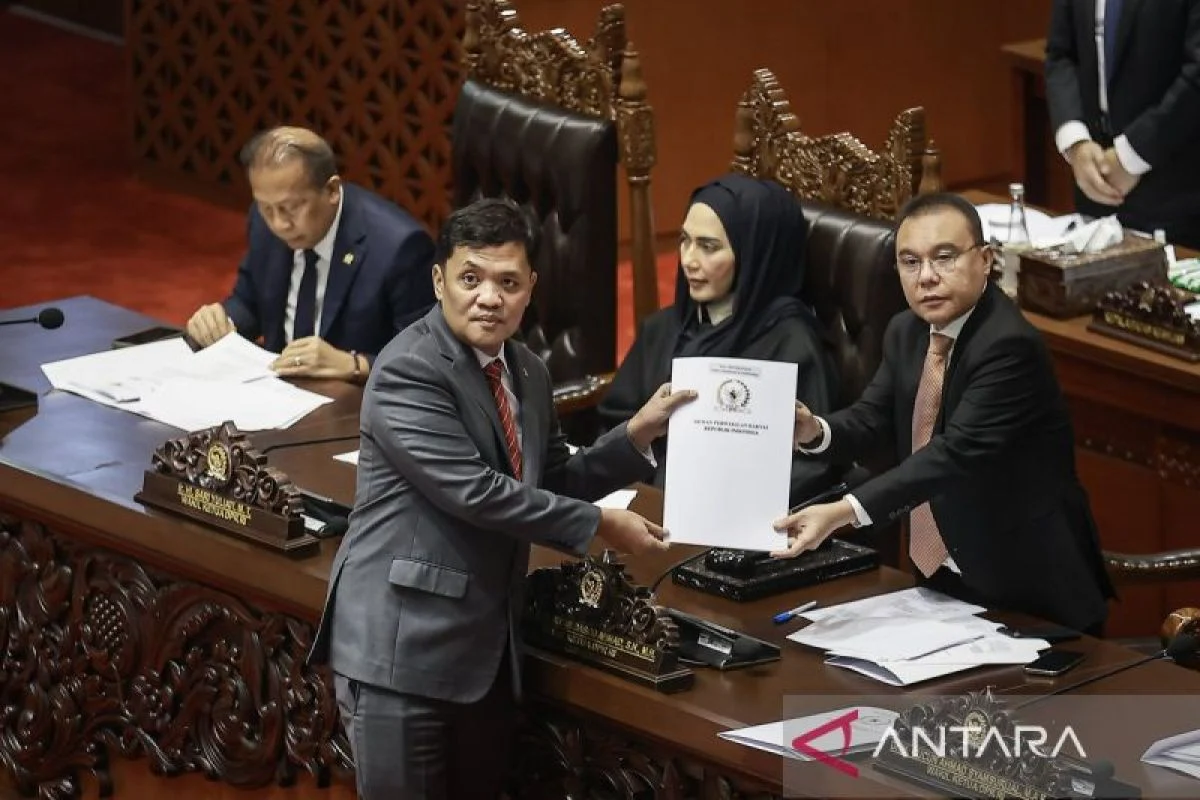
- Mid-2026: Following rigorous debates in legislative sessions, the DPR RI Plenary Meeting formally approved the Bill on the Police to be enacted into law. Government representatives, including statements from the Ministry of Law and Human Rights (Kemenkum), consistently defended the legislative process, emphasizing that the drafting adhered strictly to constitutional norms and statutory procedures without violating existing administrative laws.
- June 17, 2026: The legislation officially received state sanction, becoming Undang-Undang Nomor 5 Tahun 2026 and instantly replacing the foundational 2002 parameters across all regional and national police directorates.
Constitutional Challenge at the Mahkamah Konstitusi
Despite its formal enactment and immediate implementation, the amended retirement framework quickly became the subject of intense legal scrutiny. On October 7, 2026, the Constitutional Court (Mahkamah Konstitusi / MK) convened its inaugural hearing regarding Case Number 362/PUU-XXIV/2026, a formal judicial review petition challenging the constitutional validity of Pasal 30 ayat (5) and the accompanying transitional provisions of Law Number 5 of 2026.
The petitioners—comprising legal advocates, civic representatives, and concerned citizens—argued that the differentiation of retirement ages based on structural ranks introduces systemic inequalities within the public service sector. Specifically, the plaintiffs contended that establishing higher retirement ceilings for specific officer tiers while maintaining or altering others creates operational stratification and disrupts equitable career advancement curves for junior personnel. The petition formally asked the Constitutional Court to annul the tiered structure and mandate a standardized retirement age ceiling of 58 years across all ranks within the police force.
During the opening session, the MK panel of constitutional justices conducted an initial formal review of the application’s legal standing and substantive arguments. The bench provided structural and procedural recommendations to the petitioners for refining their legal arguments, granting a statutory window of 14 working days to resubmit perfected documentation. Legal analysts observed that because the petition remains in the preliminary examination phase, the challenged provisions of Law Number 5 of 2026 maintain full legal force and effect. Until the Constitutional Court issues a final, binding verdict, police human resource divisions nationwide are legally obligated to process retirements and service extensions strictly in accordance with the 2026 statute.
Implications for Institutional Dynamics and Career Mobility
The implementation of the new police retirement age framework carries profound systemic implications for the internal dynamics of the Indonesian National Police. From an institutional perspective, retaining officers until ages 59 and 60 ensures that the organization capitalizes on decades of accumulated command experience, crisis management expertise, and specialized technical capabilities. In an era where law enforcement agencies globally must navigate sophisticated transnational crimes, economic fraud, and digital security threats, the retention of seasoned senior and mid-level officers provides vital structural continuity.
Conversely, labor economists and public administration experts note a distinct trade-off regarding career mobility. A higher retirement ceiling naturally decelerates the natural upward rotation of personnel. When senior officers remain in active service for an additional one to two years, promotional pipelines for junior inspectors and middle-ranking officers experience a temporary bottleneck. This dynamic can potentially lower promotional velocity, leading to increased competition for vacant structural posts and heightened pressure on internal meritocracy systems to ensure transparent evaluations.
As the Constitutional Court deliberates on the judicial review petition and the police institution adapts to the administrative realities of the new statutes, the ultimate success of Law Number 5 of 2026 will depend on transparent implementation, rigorous performance evaluations for extended personnel, and balanced human resource planning. For now, Indonesia’s law enforcement apparatus operates under a redefined chronological horizon, marking a pivotal chapter in the ongoing modernization and professionalization of the national police force.