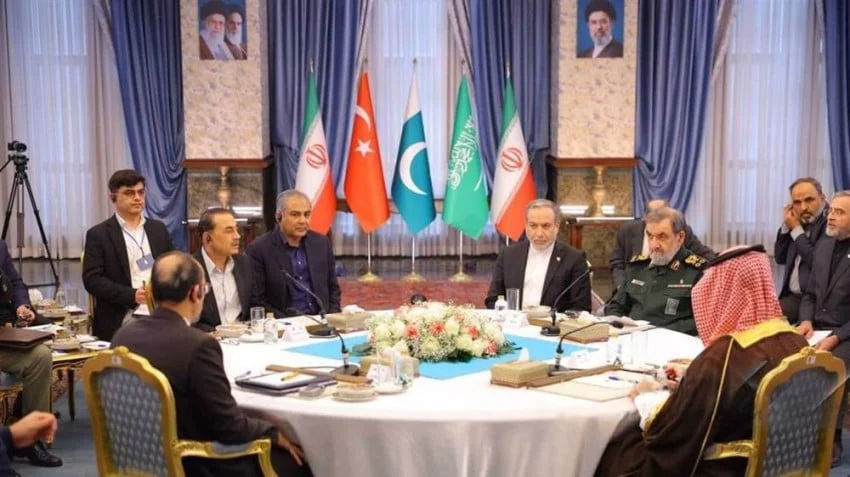
The geopolitical landscape of the Middle East is undergoing a profound and potentially historic transformation as senior military and intelligence officials from Saudi Arabia, Pakistan, and Turkey convened in Teheran this week to engage in direct security dialogues with Iranian leadership. This high-level gathering, involving Saudi Defense Minister Prince Khalid bin Salman, Pakistani Army Chief Asim Munir, and Turkish Intelligence Chief Ibrahim Kalin, marks a significant departure from the containment-focused policies that have characterized regional dynamics for decades. Meeting with Mohsen Rezaei, Secretary of the Supreme National Security Council of Iran, these representatives are navigating a complex web of existing defense pacts and the urgent necessity for regional stability amidst persistent tensions between Iran and the United States.
The Genesis of the Mekkah Defense Alliance
To understand the weight of these negotiations, one must examine the emergence of the Mekkah Defense Alliance. Signed in August 2026, the pact established a formal collective security framework between Riyadh, Islamabad, and Ankara. The core tenet of the agreement—that an armed attack against one member constitutes an attack against all—represented a paradigm shift in the Islamic world’s security posture. By integrating Saudi Arabia’s vast financial resources and energy market influence with Pakistan’s nuclear deterrent capabilities and Turkey’s advanced military-industrial complex and NATO-aligned strategic depth, the alliance aimed to create an unprecedented counterweight to regional instability.
However, the reality of the Middle East has proven more nuanced than the formal text of the treaty. Despite its formation against a backdrop of anxiety regarding Iran’s regional influence and the activities of its proxies, the alliance has faced internal and external friction. Frequent cross-border provocations by the Houthi movement in Yemen, which maintains deep ideological and logistical ties to Teheran, have placed Riyadh in an impossible position: maintain the hawkish stance of the alliance or pursue a pragmatic de-escalation that ensures the survival of its critical energy infrastructure.
Chronology of Shifting Alignments
The path to this week’s meeting in Teheran was not sudden; it was the culmination of a multi-year diplomatic evolution:
- 2023–2025: A period defined by the normalization of relations between Saudi Arabia and Iran, brokered by regional intermediaries. This phase signaled that economic interests were beginning to outweigh ideological rivalries.
- August 2026: The formal signing of the Mekkah Defense Alliance, intended to solidify a Sunni-led security bloc to provide a unified front against regional threats.
- Late 2026–2027: Escalating Houthi drone and missile strikes against Saudi energy facilities and maritime shipping lanes, testing the resolve of the Mekkah Alliance and exposing the limitations of purely military deterrence.
- Early 2028: Persistent U.S.-Iran naval tensions in the Persian Gulf, which underscored the risk of a broader conflict that would devastate regional economies.
- Current Week: The Tehran Summit, where representatives from the Mekkah Alliance met with Iranian security officials to discuss "endogenous security"—a framework aimed at regional self-reliance.
The Concept of Endogenous Security
Central to the discussions in Teheran is the Iranian-promoted concept of "endogenous security." Esmaeil Baghaei, spokesperson for the Iranian Ministry of Foreign Affairs, has articulated this vision as a move away from reliance on external security guarantees—namely those provided by the United States—in favor of a framework built upon the capabilities and shared interests of regional stakeholders.
From Teheran’s perspective, the presence of foreign military bases and the traditional U.S. "security umbrella" have historically exacerbated regional volatility. By inviting the Mekkah Alliance members to discuss regional security, Iran is positioning itself as an essential pillar of a new, post-American security architecture. This shift reflects a growing consensus among regional powers that the unpredictability of Western political cycles necessitates a local mechanism for conflict resolution and crisis management.
Strategic Implications and Data Analysis
The integration of Pakistan into this security architecture adds a unique dimension. As a nuclear-armed state with significant influence in both the Middle East and Central Asia, Pakistan’s role as a mediator between Riyadh and Teheran is historical. By bringing Turkey—a NATO member—into the fold, the scope of the dialogue broadens significantly. Turkey’s defense sector has seen exponential growth, with its domestic drone technology (such as the Bayraktar TB2) becoming a staple of modern asymmetric warfare.
Economically, the stakes are staggering. The Persian Gulf remains the world’s primary artery for hydrocarbons. Data from the International Energy Agency (IEA) indicates that over 20% of global oil consumption passes through the Strait of Hormuz. Any escalation in conflict between the Mekkah Alliance members and Iran would trigger catastrophic volatility in global energy prices. Consequently, these talks in Teheran are as much about economic survival as they are about national defense.
Official Responses and Diplomatic Positioning
The diplomatic signaling following the summit has been carefully calibrated. Turkish officials have consistently maintained that the Mekkah Defense Alliance is not an anti-Iran bloc but rather a mechanism for collective regional stability. This narrative is crucial for Ankara, which seeks to maintain a balancing act between its NATO obligations, its growing influence in the Middle East, and its functional relationship with Iran.
Conversely, the Saudi delegation’s presence signifies a calculated risk. Prince Khalid bin Salman’s participation suggests that the Saudi leadership is prioritizing the "Vision 2030" domestic agenda, which requires a stable, conflict-free environment to succeed. The willingness to engage with Mohsen Rezaei, a key architect of Iran’s regional security strategy, indicates a departure from the "maximum pressure" tactics of the previous decade in favor of a dialogue-driven approach to de-confliction.
Broader Impact on Global Geopolitics
The shift from a U.S.-centered security model to an indigenous, regional one carries profound implications for international relations. If Saudi Arabia, Pakistan, and Turkey successfully establish a working security mechanism with Iran, the traditional role of the United States as the primary security guarantor in the Persian Gulf will be significantly diminished.
- Reduced U.S. Influence: A regional security pact would likely lead to a reduction in the strategic necessity of large-scale U.S. military deployments in the region, potentially accelerating a pivot in U.S. foreign policy toward the Indo-Pacific.
- Multipolar Security: The emergence of a regional security architecture creates a multipolar environment where smaller nations must navigate between the interests of Teheran, Riyadh, and Ankara, rather than simply aligning with Washington.
- Stability through Interdependence: By linking the security of energy-producing nations (Saudi Arabia) with transit nations (Turkey/Pakistan) and regional power brokers (Iran), the framework attempts to build stability through economic and strategic interdependence.
Challenges Ahead
Despite the optimism expressed in diplomatic circles, the path forward is fraught with obstacles. The Houthi threat in Yemen remains a volatile variable. While Iran may offer assurances, the degree of control it exerts over its proxies is often debated by Western intelligence agencies. Furthermore, the internal pressure within Saudi Arabia and Pakistan to maintain a firm stance against Iranian influence remains a powerful domestic political factor.
Additionally, the reaction of the United States and its European allies will be a critical determinant of how this new architecture develops. A shift toward an independent regional security bloc may be viewed with suspicion by Western capitals, who fear the erosion of their influence and the potential for a vacuum that could be filled by other global powers like China or Russia.
As the talks in Teheran conclude, the world is watching to see if these high-level discussions will transition into a concrete, institutionalized security framework. The "endogenous security" model represents an ambitious, if untested, attempt to solve the region’s problems from within. Whether this effort will result in a durable peace or merely a temporary tactical realignment remains the most significant question in contemporary Middle Eastern geopolitics. The convergence of these regional powers signifies that the era of relying solely on external security guarantees is rapidly fading, replaced by a more complex, self-directed, and high-stakes effort to manage the regional balance of power.