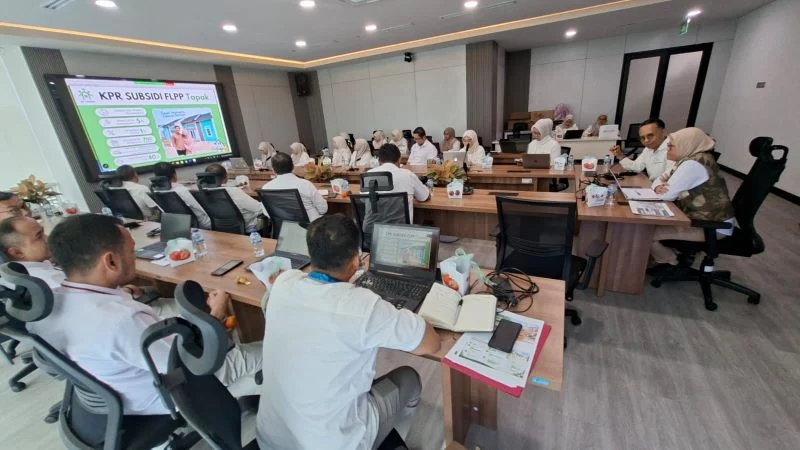
JAKARTA — The Housing Savings Agency for Public Servants, widely known as Badan Pengelola Tabungan Perumahan Rakyat (BP Tapera), has intensified its strategic outreach to underscore the critical necessity of accessible housing for Civil Servants (PNS) and Micro, Small, and Medium Enterprises (MSMEs). During a high-level briefing held at the Ministry of MSMEs, BP Tapera leadership detailed the pressing urgency of securing subsidized housing solutions for these vital segments of the workforce, aiming to mitigate a persistent national backlog that continues to affect millions of families across Indonesia.

The collaborative discourse brought to light specific structural hurdles faced by public servants and independent business operators alike. Government representatives and agency officials deliberated on actionable frameworks to streamline homeownership, emphasizing optimal geographic locations, affordable down payment structures, and collective acquisition schemes facilitated through cooperatives or the Civil Servants Corps of the Republic of Indonesia (Korpri).
Comprehensive Employee Survey Reveals Housing Preferences
To formulate a targeted approach, the Ministry of MSMEs conducted an internal baseline survey among its personnel, yielding granular insights into the housing aspirations and financial capacities of its workforce. The data revealed a pronounced preference for landed houses, with 67.6 percent of surveyed employees favoring single-family landed properties over vertical alternatives such as apartments or condominiums.

Regarding financial structuring, respondents indicated an ideal monthly installment range between IDR 1 million and IDR 2 million. Christina Agustin, Deputy for Medium Enterprises at the Ministry of MSMEs, elaborated on the survey metrics during a press briefing, noting the stark reality of the current housing deficit among civil state apparatuses.
"Out of 105 total respondents, as many as 60 employees do not yet own a home of their own," Agustin stated. "Furthermore, approximately 83.8 percent of these respondents prefer a mortgage tenure ranging from 5 to 15 years, while a small cohort of four individuals opted for extended tenure options exceeding 20 years."

These findings provide a vital empirical foundation for policymakers. Sid Herdi Kusuma, Deputy Commissioner of BP Tapera, emphasized that such empirical datasets are indispensable for structuring future governmental interventions and designing responsive financial products.
"Should the Ministry of MSMEs plan to host an institutional housing exhibition or expo, we stand fully prepared to deliver comprehensive institutional support, particularly from the development and banking sectors," Kusuma remarked, highlighting the agency’s commitment to facilitating cross-sector partnerships.

Navigating Application Protocols and Digital Housing Maps
Building upon the strategic framework, Mungki Indriati Pratiwi, Head of the Marketing Division at BP Tapera, delivered an in-depth technical presentation. Pratiwi outlined the procedural workflows and mandatory eligibility criteria required for prospective applicants to access state-backed housing subsidies. Additionally, she demonstrated the utility of SiKumbang—the Housing Developer Collection Information System—which serves as a centralized digital map tracking the availability, distribution, and construction progress of subsidized residential units nationwide.
The integration of digital platforms like SiKumbang marks a concerted effort by BP Tapera to enhance transparency and accelerate matching between housing demand and certified supply. By bridging the gap between developers, banking institutions, and end-users, the agency aims to eliminate bureaucratic friction that has historically slowed the absorption rate of subsidized quotas.

The Broader Economic Landscape: MSMEs and Financial Inclusion
The push for subsidized housing targeting MSMEs arrives at a critical juncture for Indonesia’s broader economic ecosystem. Official data released by the Ministry of MSMEs in April paint a vivid picture of the sector’s monumental scale and persistent vulnerabilities. Active MSMEs operating across the archipelago number approximately 66 million, collectively absorbing roughly 117 million workers. This staggering figure accounts for approximately 97 percent of the nation’s total domestic workforce, underpinning a massive 60.51 percent contribution to Indonesia’s Gross Domestic Product (GDP).
Despite their macroeconomic dominance, a significant structural paradox persists: an estimated 44 million MSME operators remain entirely unserved or underserved by formal financial institutions. Commercial banks and institutional lenders have historically exhibited extreme caution when extending credit lines to small-scale entrepreneurs, primarily due to stringent collateral requirements, volatile cash flows, and minimal formal financial transaction histories.

This financial exclusion extends directly into the realm of real estate. Without verified income documentation or formal tax reporting, independent vendors, traditional market traders, and small business owners frequently find themselves disqualified from traditional mortgage products, leaving homeownership perpetually out of reach.
Policy Implications and Future Outlook
The proactive synergy between BP Tapera and the Ministry of MSMEs represents a pivotal shift toward inclusive social protection policies. By recognizing civil servants and informal-leaning MSME workers as dual pillars of national stability, the government is attempting to architect a more resilient social safety net that incorporates long-term asset accumulation.

Observers and housing sector analysts note that addressing the housing backlog requires more than capital injection; it demands institutional innovation. By utilizing cooperative models and tailoring mortgage tenures to match the financial realities of small business operators, stakeholders can unlock a dormant wave of residential demand.
As BP Tapera continues its nationwide promotional campaign, the ultimate success of these initiatives will rely heavily on cross-ministerial execution, sustained liquidity from participating banks, and rigorous oversight of housing quality. For millions of hardworking Indonesians striving for the dignity of a permanent home, these policy alignments offer a tangible pathway from tenancy to security.