The Komisi Pemberantasan Korupsi (KPK), Indonesia’s anti-graft agency, has formally pledged its support to the Indonesian National Police (Polri) as the latter proceeds with a landmark criminal investigation into a sprawling illegal wiretapping network. The scandal, which has shaken the highest echelons of the state, involves a group of high-ranking officials—most notably former National Police Chief Listyo Sigit Prabowo (LSP)—accused of orchestrating unauthorized surveillance against a broad spectrum of political and institutional figures. The confirmation of the KPK’s involvement as a target of this illicit operation has transformed the case from a departmental breach into a significant national security crisis.
The situation came to a head on November 12, 2026, when National Police Chief Jenderal Polisi Suyudi Ario Seto testified before the House of Representatives (DPR) Commission III. During the session, he disclosed that the scope of the illegal surveillance operation was unprecedented, encompassing the President of the Republic of Indonesia, members of the Presidential inner circle, senior cabinet ministers, members of the legislature, regional heads, and leaders of law enforcement agencies, including the KPK and the Attorney General’s Office.
Chronology of the Investigation and Legal Proceedings
The investigation into this clandestine network began to gain momentum in early November 2026. On November 3 and 5, 2026, the National Police officially named four high-ranking officials as suspects. The charges against them include unauthorized electronic wiretapping and the unlawful deletion of digital evidence.
The identified suspects are:
- LSP: The former Chief of the Indonesian National Police.
- AS: The former Head of the Legal Division (Kadivkum) of the National Police.
- EH: A Widyaiswara (senior instructor) at the National Police Education and Training Institute (Lemdiklat).
- SU: The former Head of the Information and Communication Technology Division (Kadiv TIK).
The legal process moved with relative speed following the announcement of these charges. On November 10, 2026, the National Police conducted an ethics hearing concerning suspect AS. The panel determined that his actions constituted a severe violation of the institutional code of conduct, leading to a sentence of dishonorable discharge (PTDH) from the police force. While the investigation remains ongoing, the authorities have faced a logistical challenge regarding suspect SU, who remains under medical supervision following a stroke, effectively delaying his detention and interrogation.
KPK Response and Stance on Institutional Security
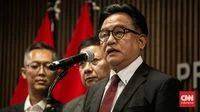
Addressing the press at the KPK’s Merah Putih Building on November 12, KPK spokesperson Budi Prasetyo emphasized the agency’s commitment to institutional integrity and cooperation with the police. "The KPK respects and supports the law enforcement process currently being conducted by the National Police," Budi stated.
He clarified that the wiretapping of KPK personnel, while alarming, does not appear to be linked to any specific active corruption cases or ongoing investigations handled by the agency. "The National Police Chief has clarified that the objects of this wiretapping were not necessarily targeted due to their involvement in specific criminal cases, but rather because of their strategic positions," Budi added.
While the KPK acknowledges its status as a victim of this surveillance, Budi noted that the agency has not yet been briefed on the specific identities of the KPK officials targeted or the duration of the monitoring. He characterized this information as part of the sensitive material of the ongoing police investigation, which the KPK respects. The agency remains confident that the National Police will maintain transparency as the evidence is processed and the legal case progresses toward the court phase.
Broader Context and Implications for Public Trust
The revelation that a former Chief of Police stands accused of overseeing a state-wide surveillance operation has profound implications for the Indonesian legal system. In many democratic societies, the integrity of the "trias politica"—the separation of powers between the executive, legislative, and judicial branches—is protected by strict regulations regarding intelligence gathering.
The alleged use of state resources to surveil the President, political rivals, and fellow law enforcement agencies suggests a significant lapse in the internal oversight mechanisms of the National Police. Analysts observe that this case will likely necessitate a comprehensive audit of the police’s technology infrastructure and a tightening of the protocols governing the use of electronic interception tools.
Furthermore, the involvement of the KPK adds a layer of complexity to the public perception of the anti-graft agency. For years, the KPK has been a lightning rod for political pressure. The discovery that its internal communications may have been compromised by an entity within the security establishment raises concerns regarding the confidentiality of whistleblower information and the security of evidence in high-profile corruption trials.
Data Security and the Threat to Democratic Institutions
The illegal deletion of electronic data cited by the National Police suggests that the suspects were not only gathering intelligence but also actively sanitizing their tracks to avoid detection. This element of the crime points to a sophisticated understanding of digital forensic protocols. For the Indonesian government, the task is now twofold: to prosecute the individuals responsible and to restore public confidence in the agencies tasked with protecting the state.
The inclusion of activists, students, and NGOs in the list of targets reported by Jenderal Suyudi suggests that the operation was also designed to monitor dissent and civil society movements. This has prompted calls from various human rights organizations for a parliamentary inquiry to determine the extent of the political motivations behind the wiretapping.
Future Trajectory of the Case
As the National Police continue their investigation, the focus will likely shift to the following key areas:
- The Scope of Compromised Data: Determining what information was extracted and whether it was used to influence political decisions or legal outcomes.
- Institutional Reforms: Evaluating the oversight mechanisms for the Division of Information and Communication Technology (Div TIK) to prevent future abuses.
- Judicial Process: Managing the high-profile trials of the four suspects to ensure that the process is seen as impartial and robust, given the seniority of the individuals involved.
The KPK’s proactive stance in supporting the police investigation is seen as a strategic move to insulate the agency from further suspicion and to demonstrate its commitment to the rule of law. By publicly aligning itself with the National Police’s corrective measures, the KPK is attempting to signal to the public that it remains an independent actor, despite having been a target of the very surveillance system it is now helping to expose.
In the coming weeks, the Indonesian public and international observers will be watching closely as the National Police release further details. The resolution of this case will serve as a litmus test for the current administration’s willingness to hold its most powerful law enforcement officials accountable for systemic abuse of power. The outcome will inevitably reshape the relationship between the National Police, the KPK, and the institutions they are mandated to protect, potentially marking a watershed moment in the history of Indonesian law enforcement.
As Jenderal Suyudi noted during his testimony, the investigation is not merely a procedural matter but a necessary step to cleanse the ranks of the National Police and ensure that the tools of the state are used exclusively for the benefit of the nation, rather than the personal or political interests of a select few. The road ahead remains fraught with legal and political hurdles, but the unified front presented by the KPK and the National Police suggests a concerted effort to address the breach of trust at its core.