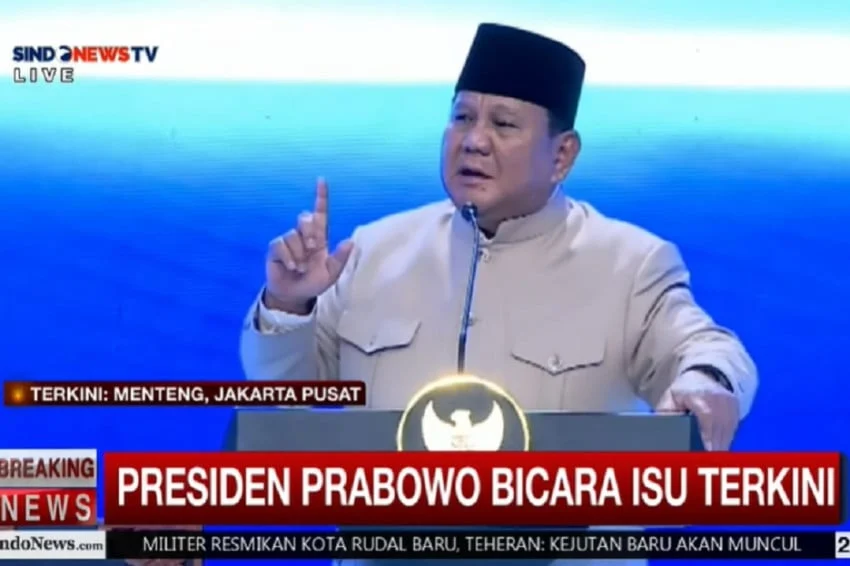
JAKARTA — President Prabowo Subianto forcefully condemned what he termed the "Indonesia Gelap" (Dark Indonesia) narrative, labeling it as a malicious creation orchestrated by identifiable individuals with hostile intentions. Speaking before a packed auditorium of party cadres, officials, and supporters during the celebration of the 15th anniversary of the NasDem Party in Jakarta on Wednesday, November 11, 2026, the Indonesian Head of State maintained an assertive tone as he addressed national economic optimism, political dynamics, and the psychological resilience required to navigate complex geopolitical and domestic challenges.
The remarks, which quickly captured public attention and dominated national news cycles, underscored the administration’s sensitivity to pessimistic public discourse regarding Indonesia’s trajectory. President Prabowo emphasized that the nation possesses abundant natural and human resources, making defeatist narratives not only inaccurate but deliberately subversive.
Main Facts of the Presidential Address
During his address at the anniversary commemoration, President Prabowo dedicated a significant portion of his speech to dismantling pessimistic projections about the country’s future. He argued that the propagation of the "Indonesia Gelap" framing is a coordinated effort designed to erode public trust in state institutions and dampen national morale.
"Brothers and sisters, such is the philosophy to which I invite you. Our nation is rich, trust me. That Indonesia Gelap narrative, that is evil! And it was made by evil people. And the evil people are already known, brothers and sisters," President Prabowo stated emphatically during the event.
The President contextualized these remarks by urging the citizenry to reject despair when confronted with socioeconomic difficulties or political friction. He posited that brooding over structural challenges yields no productive outcomes, advocating instead for collective action, productivity, and unwavering faith in the nation’s economic fundamentals.
Furthermore, the speech touched upon the current political atmosphere, with the President humorously yet pointedly referencing the high-stakes environment of governance. "These past few days have been full of dynamics, who knows, maybe I am being wiretapped," he remarked in a candid moment, highlighting the pervasive nature of security concerns and political surveillance in high-office administration.
Background Context and Chronology of the Narrative
To understand the weight of President Prabowo’s statements, it is necessary to examine the evolution of the "Indonesia Gelap" terminology within Indonesia’s sociopolitical landscape. The phrase has intermittently surfaced during critical political junctures—most notably during election cycles, periods of economic uncertainty, or contentious legislative debates—serving as a catch-all descriptor utilized by critics, opposition figures, or grassroots activists to protest government policies, alleged democratic regression, or economic hardships.
In the months leading up to November 2026, the administration faced multifaceted challenges, including global supply chain adjustments, inflationary pressures, and intense domestic debates regarding resource management and fiscal policy. As opposition voices and digital commentators amplified critiques under various banner hashtags, the administration evidently identified a concerted effort to frame national development efforts as failing.
The decision to address this head-on during a major political party’s anniversary celebration was strategically calculated. The NasDem Party, a key coalition member within the broad-based government alliance, provided an ideal platform to reinforce coalition solidarity and rally political elites behind the executive branch’s vision of national progress.
Economic Foundations and Resource Wealth
At the core of President Prabowo’s rebuttal is the fundamental thesis of Indonesia’s material wealth. The administration has consistently anchored its economic legitimacy in the policy of downstreaming (hilirisasi)—a strategic initiative initiated under the previous administration and aggressively expanded under Prabowo’s tenure, aimed at retaining raw material value domestically through local processing of minerals such as nickel, bauxite, and copper.
Data from Statistics Indonesia (BPS) and international financial institutions indicate that Indonesia maintains a resilient macroeconomic profile, with steady gross domestic product (GDP) growth hovering around 5 percent annually. Despite global economic headwinds marked by high interest rates in developed economies and geopolitical fragmentation, Indonesia has managed to curb domestic inflation within target corridors and maintain a stable foreign exchange reserve position.
Proponents of the administration’s economic stance argue that these empirical metrics starkly contradict the premise of an "Indonesia Gelap." They point to ongoing infrastructure development, social assistance programs aimed at poverty alleviation, and expansive food and energy security initiatives as evidence of a forward-moving nation rather than one plunging into obscurity.
Political Implications and Reactions
The President’s assertion that the architects of the pessimistic narrative "are already known" has triggered intense speculation across political circles in Jakarta. Analysts and political observers have weighed in on whether this implies impending legal actions, intelligence surveillance disclosures, or purely political deterrence directed at domestic critics.
Political communication experts note that framing political opposition or critical public discourse as the work of "evil people" (orang-orang jahat) is a potent rhetorical device. While it galvanizes loyal supporters and reinforces an "us versus them" solidarity paradigm, critics and civil society organizations caution that such language risks narrowing the tolerance for constructive dissent.
Representatives from various political factions have offered contrasting viewpoints. Coalition partners welcomed the President’s firm stance, interpreting it as a necessary defense of national dignity against what they view as psychological warfare aimed at destabilizing investor confidence. Conversely, opposition figures and civil liberties watchdogs have urged the administration to differentiate between malicious disinformation campaigns and legitimate criticism of public policy, emphasizing that freedom of expression remains a cornerstone of Indonesia’s democratic framework.
Fact-Based Analysis of Broader Implications
The friction between optimistic state narratives and critical public discourse highlights a broader struggle over the management of national perception in the digital age. As social media algorithms increasingly reward sensationalism and polarized viewpoints, governance in Indonesia faces the dual challenge of delivering tangible developmental results while managing information integrity.
From an investment perspective, macroeconomic stability heavily relies on investor sentiment. Narrative framing plays a critical role in how foreign and domestic capital evaluates sovereign risk. By directly confronting the "Indonesia Gelap" narrative, President Prabowo aimed to project strength, certainty, and administrative control, reassuring markets that the state apparatus is fully cognizant of attempts to undermine national stability.
However, analysts suggest that the most effective antidote to pessimistic narratives remains empirical policy outcomes—specifically, job creation, wealth distribution, price stability, and the tangible reduction of economic inequality. As the Prabowo administration continues to roll out its strategic agenda, the test will lie in whether macroeconomic indicators translate into perceived well-being for the broader population, thereby naturally rendering defeatist slogans obsolete.
The events surrounding the NasDem 15th anniversary underscore a pivotal moment in contemporary Indonesian politics, where the battle for the nation’s narrative is fought with as much intensity as the formulation of policy itself.