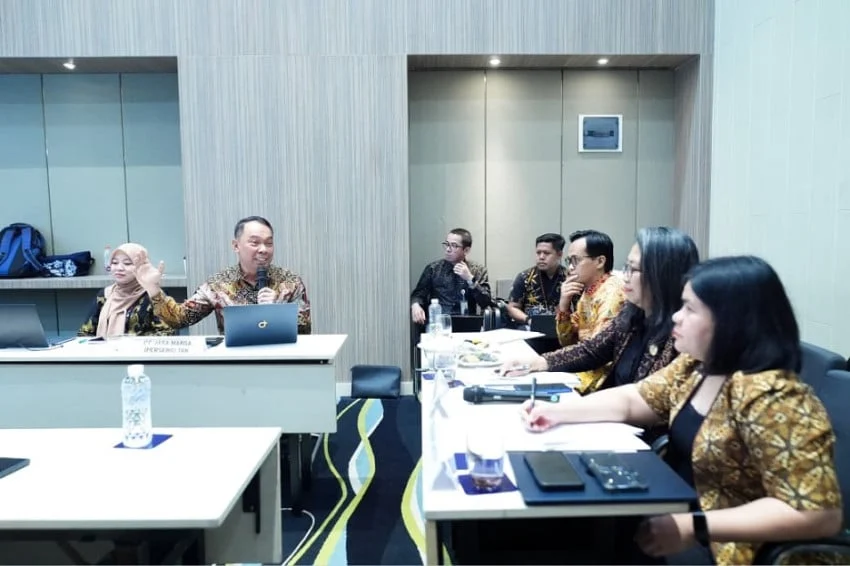
PT Jasa Marga (Persero) Tbk has reaffirmed its steadfast dedication to corporate transparency, accountability, and superior public service by participating in the 2026 Public Information Monitoring and Evaluation (Monev KIP) Public Test Presentation. Organized by the Central Information Commission (KIP) in Jakarta on Wednesday, November 11, 2026, the high-profile evaluation serves as a national benchmark for measuring how effectively public bodies and state-owned enterprises implement the principles of open governance mandated by national legislation.
The strategic presentation underscores Jasa Marga’s ongoing transition toward a modern, digitally integrated public corporation. As the premier toll road operator in Indonesia, managing a vast network that bridges critical economic corridors across the archipelago, the company views transparency not merely as a legal compliance obligation, but as an operational necessity and a fundamental pillar of public trust.
Strategic Vision for Transparent Public Governance
During the evaluation session before the panel of commissioners, Jasa Marga’s President Director, Rivan A. Purwantono, emphasized that public information disclosure is deeply embedded within the company’s broader transformation agenda. Modern corporate governance requires organizations to operate in a fishbowl environment where information flows seamlessly between the entity and its stakeholders.
"We are firmly committed to establishing Jasa Marga as a highly trusted public body driven by transparent, accountable, participatory, and digitally enabled information management," Rivan stated during his presentation. He further explained that this commitment transcends basic regulatory fulfillment. The company actively fosters an internal culture of openness across all operational tiers, ensuring that personnel at every level remain highly responsive to the evolving informational needs of the motoring public.
This philosophical approach aligns with modern expectations of state-owned enterprises (SOEs). In an era where consumers and citizens demand immediate access to corporate data, financial stewardship updates, and operational metrics, Jasa Marga has positioned itself at the forefront of proactive disclosure. By systematically dismantling traditional bureaucratic barriers to information, the company aims to cultivate a collaborative relationship with the public it serves.
Scale of Operations and the Imperative of Real-Time Information
To fully contextualize Jasa Marga’s information disclosure initiatives, one must examine the sheer scale of its operations. As the dominant player in Indonesia’s toll road sector, the company currently holds concessions spanning 1,736 kilometers, out of which 1,318 kilometers across 36 distinct operational toll road segments are actively managed and open to the public.
This vast infrastructural web carries an immense daily burden. Statistics indicate that approximately 3.6 million vehicles traverse Jasa Marga’s network every single day. This massive volume of daily commuters, commercial freight carriers, and long-distance travelers generates a continuous, dynamic demand for accurate, up-to-the-minute travel information. Motorists require immediate insights regarding traffic congestion, accident reports, weather conditions, lane reversals, construction zones, and rest area capacities to make informed routing decisions.
Meeting this relentless demand for data requires a sophisticated technological infrastructure capable of processing millions of data points in real time. Jasa Marga has systematically integrated cutting-edge technological solutions to bridge the gap between complex highway operations and consumer-facing informational needs.
Technological Integration: The Role of JMTC and ITS
At the heart of Jasa Marga’s operational intelligence lies the Jasa Marga Tollroad Command Center (JMTC). Established as a centralized hub for traffic monitoring and crisis control, the JMTC operates on a 24/7 basis, overseeing the entire expanse of the company’s toll road network.
The command center is powered by an extensive surveillance and data-gathering network comprising more than 3,500 closed-circuit television (CCTV) cameras strategically positioned along the highways. These cameras are complemented by advanced electronic toll collection data feeds, weight-in-motion sensors, and various Internet of Things (IoT) devices. All incoming streams are synthesized through an advanced Intelligent Transportation System (ITS).
The ITS platform does more than simply record data; it analyzes traffic flow patterns, detects anomalies such as stalled vehicles or sudden slowdowns, and algorithmically assists operators in making rapid decisions. Crucially, the processed data is instantaneously transformed into actionable consumer information, allowing Jasa Marga to dispatch emergency response units swiftly while simultaneously broadcasting updates to the public.
Omnichannel Communication and Consumer Accessibility
Recognizing that different segments of the motoring public rely on varied communication mediums, Jasa Marga has deployed an omnichannel strategy for public information dissemination. This multi-layered approach ensures that critical travel data is accessible to anyone, anywhere, at any time.
- The Travoy Application: Serving as the flagship digital companion for Indonesian motorists, the Travoy app provides real-time CCTV monitoring feeds, interactive mapping of toll road conditions, toll tariff calculations, rest area location finders, and direct emergency assistance features.
- Call Center 133: Dedicated telephone support operating around the clock to field direct inquiries, handle emergency calls, and log customer feedback or complaints.
- Official Corporate Websites: Comprehensive online portals offering official corporate governance documents, financial statements, and sustainability reports.
- Dedicated PPID Portals: Specialized landing pages managed by the company’s Information and Documentation Management Officer (PPID) to facilitate formal requests for public information pursuant to statutory timelines.
- Verified Social Media Channels: Active, monitored social media handles delivering rapid-fire updates regarding major traffic incidents, holiday travel advisories, and operational policy changes.
Through these diverse channels, millions of travelers can seamlessly check real-time traffic conditions, estimate travel times, verify toll tariffs, locate available rest areas equipped with specific amenities, and file grievances or request roadside assistance without encountering administrative friction.
Proactive Disclosure and Institutional Strengthening
Beyond reacting to consumer inquiries, Jasa Marga has institutionalized a policy of proactive disclosure (proactive disclosure). In accordance with national freedom of information frameworks, the company systematically categorizes and publishes public information across three distinct statutory mandates: periodic information, immediate information regarding emergencies or public threats, and information that must be made available at all times.
To ensure this framework functions effectively across its sprawling organizational structure, Jasa Marga has significantly reinforced the institutional capacity of its PPID unit. The company has enacted internal standard operating procedures for information governance, conducted regular training workshops for designated information officers across all operational units, and established robust auditing mechanisms to measure compliance and responsiveness.
These measures ensure that information requests are handled transparently, fairly, and within legally mandated timeframes. By decentralizing the commitment to transparency down to regional operational units, Jasa Marga ensures that localized information is captured and disseminated with minimal delay.
Broader Implications and Industry Benchmark
Jasa Marga’s active participation in the 2026 Monev KIP evaluations highlights several broader implications for state-owned enterprises and public bodies in Indonesia. As infrastructure development accelerates nationwide, public expectations regarding corporate governance and operational transparency have risen exponentially.
By submitting its information governance practices to rigorous external evaluation by the Central Information Commission, Jasa Marga demonstrates accountability not only to regulators but to the millions of citizens who rely on its infrastructure daily. Transparent governance in toll road operations directly correlates with improved traffic safety, reduced economic friction through better logistical planning, and enhanced public confidence in state-managed assets.
Furthermore, Jasa Marga’s heavy reliance on digital command centers and omnichannel dissemination establishes a benchmark for other infrastructure and utility companies. In an increasingly interconnected economy, the integration of physical civil engineering with digital information systems represents the future of public service delivery.
As the 2026 Monev KIP proceedings conclude, Jasa Marga’s comprehensive presentation serves as a testament to the evolving nature of corporate transparency. By coupling massive infrastructural reach with sophisticated digital communication tools and an unwavering institutional commitment to openness, the company continues to redefine the standards of public accountability in Indonesia’s transportation sector.